
Bet Like a Pro – Essential Expert Sports Betting Tips
On this page
If you’re ready to go beyond basic sports betting strategy, this section delivers advanced sports betting tips and insights used by professional bettors. Whether you want to improve your match analysis, understand betting markets more deeply, or develop a more structured betting approach, these expert guides will help you take the next step.
We recommend starting with our dedicated guide on bankroll management – the foundation of every long-term profitable betting strategy. Learning how to manage your betting budget effectively, control risk, and avoid emotional decisions is one of the most important skills for anyone aiming to succeed in sports betting over time.
After that, our sports betting experts share their knowledge in a series of focused, easy-to-read articles. Each guide takes only a few minutes to go through but provides practical, actionable insights designed to sharpen your betting decisions, improve your odds analysis, and help you build long-term profitability as a smarter bettor.

Bankroll Management in Sports Betting
Bankroll management is one of the most critical concepts in sports betting strategy. It refers to the systematic process of managing your available betting funds – deciding how much to stake on individual wagers and how to allocate capital across different bets. In practical terms, bankroll management provides the strategic framework behind every betting decision and plays a crucial role in protecting your capital during inevitable losing streaks.
Even professional bettors with a proven ability to beat the bookmakers over time can fail in practice due to poor bankroll management. Poor staking discipline, chasing losses, or placing an excessive percentage of the bankroll on a single bet can wipe out even a genuine betting edge within a short period. This is why bankroll management is widely considered a foundational skill for anyone aiming to approach sports betting in a structured and sustainable way.
From our perspective, the ability to implement a clear bankroll management strategy is the single most important factor separating successful sports bettors from losing ones. Technical betting skill alone is not enough. Staying disciplined during periods of variance and losing streaks – and not deviating from your staking plan – is what determines long-term profitability in sports betting."
Who Needs Bankroll Management? Why Every Sports Bettor Benefits
A structured bankroll management strategy is an absolute requirement for professional bettors — but recreational bettors benefit just as much from applying the same principles. Even if you bet primarily for entertainment, disciplined bankroll management significantly increases your chances of finishing in profit over time and makes the overall betting experience more sustainable.
More importantly, bankroll management protects casual bettors from depleting their entire betting balance in a short period. Uncontrolled stakes, emotional betting decisions, and impulsive wagers after losses are among the most common reasons bettors lose money faster than necessary. By introducing structure and discipline into your staking approach, bankroll management helps bettors at all levels wager in a more controlled, rational, and sustainable way.
The key benefits of disciplined bankroll management in sports betting include:
- Protecting your bankroll from heavy losses on a single bet
- Preventing loss chasing and reckless recovery attempts
- Reducing overconfidence during winning streaks
- Supporting rational, data-driven betting decisions
- Often becoming the decisive factor between long-term profit and consistent losses
How Large Should Your Sports Betting Bankroll Be?
The size of your sports betting bankroll is a personal decision, as financial situations and risk tolerance vary significantly from bettor to bettor. What matters most is that your bankroll consists exclusively of funds you can genuinely afford to lose. Betting capital should never come from money needed for everyday expenses or upcoming financial obligations. Variance in sports betting can be substantial, and wagering with funds earmarked for living costs creates unnecessary financial pressure — and almost inevitably leads to poor betting decisions.
If you bet primarily for entertainment, defining a fixed monthly betting budget is a practical and responsible approach. Even in this scenario, applying basic bankroll management principles is strongly recommended, as it extends your betting activity and reduces the risk of losing your entire balance quickly. Recreational bettors who prefer smaller stakes and a more relaxed staking approach can still benefit from setting clear limits, even without following a fully structured betting plan.
For bettors who approach sports betting more seriously, establishing a clear bankroll management strategy is essential. Only by managing your betting capital with discipline and consistency can you realistically create the conditions needed for long-term profitability. The next step is understanding how to structure that bankroll — and how much to stake on each individual bet.
What Is a Unit in Sports Betting?
In sports betting, a unit is a standardised measure of stake size expressed as a percentage of your total bankroll. Using units instead of fixed monetary amounts allows bettors with different bankroll sizes to follow the same staking recommendations. When we suggest a bet, recommending “1 unit” is universally applicable — whereas a fixed monetary amount could represent an entire bankroll for one bettor and just 0.1% for another. As a general baseline, your bankroll should consist of at least 50 units, although we recommend working with 100 or ideally 200 units for stronger bankroll protection.
As a practical guideline, a single bet should typically represent around 1% to 3% of your total bankroll — an approach commonly known as flat staking or fixed staking. More conservative bettors may prefer to stay within the 1% to 2% range, while more aggressive staking strategies can involve risking up to 5% per wager. However, we strongly advise against consistently staking at this higher level. The impact of variance increases significantly with larger stake percentages, and shrinking bankrolls often force bettors to abandon otherwise sound strategies before they have the opportunity to generate long-term profitability.
100-Unit Bankroll Strategy - Why It Works for Most Sports Bettors
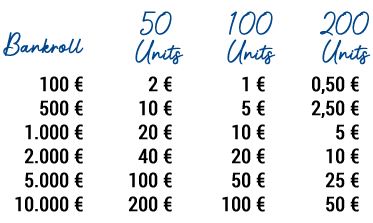
For most bettors, a 100-unit bankroll offers the ideal balance between variance protection and practical usability. Operating with fewer than 100 units is possible — as few as 50 units can work if you can comfortably reload your bankroll without financial pressure — but it leaves less margin to absorb losing streaks. More risk-averse bettors may prefer a 200-unit structure, which further reduces variance and increases long-term stability, although it requires either a larger initial capital base or smaller individual stakes.
To illustrate how unit sizing works in practice, consider a 100-unit bankroll. With a total betting bankroll of €100, one unit equals €1. With €1,000, one unit equals €10. This proportional relationship is the key principle: as your bankroll grows, your unit size increases accordingly — and if your bankroll shrinks during a losing period, your unit size should decrease in the same proportion. This dynamic adjustment, often referred to as proportional staking, ensures that your stakes always remain consistent relative to your available capital. It protects you from overbetting during downswings while allowing you to fully capitalise on profitable periods.
How Many Units Should You Stake Per Bet?
The number of units you stake on an individual bet should reflect two key factors: the perceived risk of the wager and the degree of betting value you have identified. As a general rule, bettors tend to stake fewer units on higher-risk selections such as underdogs or long-shot accumulators, and more on lower-risk wagers where confidence is higher. However, risk level alone should not determine stake size. If you identify significant betting value, a larger stake may be justified even at higher odds. When our analysts believe that a bookmaker has clearly mispriced a market, we may increase the recommended stake in order to maximise the potential return from that opportunity.
To keep staking recommendations clear and consistent across all our betting tips, we use four standardised confidence levels:
- Very Low - 0.5 units (typically used for high-odds or speculative selections)
- Low - 1 unit
- Medium - 2 units
- High – 3 units
How Is Profit Measured in Sports Betting?
In sports betting, profit is measured in units rather than fixed monetary amounts — making performance directly comparable across bettors with different bankroll sizes. Stating that we are up 18 units for a season means we have generated a net profit of 18 units after all bets are settled. Depending on individual unit size, this could represent €18 for one bettor or €18,000 for another. Alongside unit profit, many experienced bettors also track their yield — the return on investment expressed as a percentage of total stakes — as a key indicator of long-term betting performance.
If your bankroll is still relatively small, early profits may appear modest in absolute terms. This is a normal and expected part of the long-term betting process. As your bankroll grows and your unit size increases proportionally, the monetary value of each profitable run compounds significantly. Consistent performance over a meaningful sample of bets, combined with disciplined bankroll management, is what ultimately separates sustainable profitability from short-term variance. Patience and discipline are not optional extras — they are the foundation of long-term betting success
What Is the Safest Bet in Sports Betting?
There is no such thing as a guaranteed winning bet. Sport is inherently unpredictable, and even the most heavily favoured selections always carry a residual level of risk. Unexpected injuries, referee decisions, tactical surprises, and simple variance make absolute certainty impossible. Nevertheless, identifying lower-risk betting opportunities — and understanding what makes one bet safer than another — is a central objective for both recreational and professional bettors.
What Makes a Bet Lower Risk?
The perceived safety of a bet depends on several interconnected factors: the underlying probability of an outcome, how accurately the bookmaker has priced the market, and the quality of pre-match analysis. For professional bettors, the goal is never to eliminate risk entirely — that is impossible in sports betting — but to consistently identify situations where the probability of winning is higher than the odds suggest, while managing exposure through disciplined staking and bankroll management.
At first glance, very low-odds selections — for example a heavily favoured team priced at 1.10 or lower — may appear to be the safest available bets. However, low odds and genuine betting safety are not the same thing. Even dominant teams can drop points due to injuries, red cards, squad rotation, or simple variance. More importantly, very short-priced favourites often offer little or no betting value, meaning the potential return rarely justifies the risk. A lower-odds bet is not automatically a safer bet — it is simply a more probable one.
To improve the overall safety and consistency of your betting strategy, apply these core principles::
- Research every bet — always understand the reasoning behind your selection before staking
- Favour single bets over accumulators — each additional selection multiplies the overall risk
- Assess value, not just probability — consider whether the odds accurately reflect the true likelihood of the outcome
- Eliminate emotional betting — backing your favourite team or chasing losses significantly increases risk
- Apply disciplined bankroll management — consistent staking protects your capital during inevitable losing runs
What Is a No Bet in Sports Betting?
There are matches where virtually any outcome seems plausible. If your pre-match analysis leads you to conclude that the uncertainty surrounding a game is too high to justify a wager, this situation is commonly referred to as a no bet. In practical terms, a no bet means deliberately choosing not to stake because the perceived risk outweighs the potential value. Recognising no-bet situations is an important skill in disciplined sports betting — avoiding weak opportunities is just as valuable as identifying profitable ones.
What Is a Surebet (Arbitrage Bet)?
Unlike conventional betting strategies, surebets — also known as arbitrage bets or arbs — are based on mathematical price discrepancies between different bookmakers. By placing calculated stakes on all possible outcomes of the same event across multiple betting operators, bettors can lock in a guaranteed profit regardless of the final result. For this reason, arbitrage betting is often considered the only sports betting approach that can be theoretically risk-free in terms of match outcome.
In practice, however, surebet opportunities usually offer relatively small profit margins, which means that meaningful returns often require higher total stakes. In addition, bookmakers actively monitor price discrepancies and may adjust odds quickly or apply staking limits on certain markets. This makes successful arbitrage betting more operationally demanding and time-sensitive compared to traditional value betting strategies..
Example: Surebet in a Two-Way Market
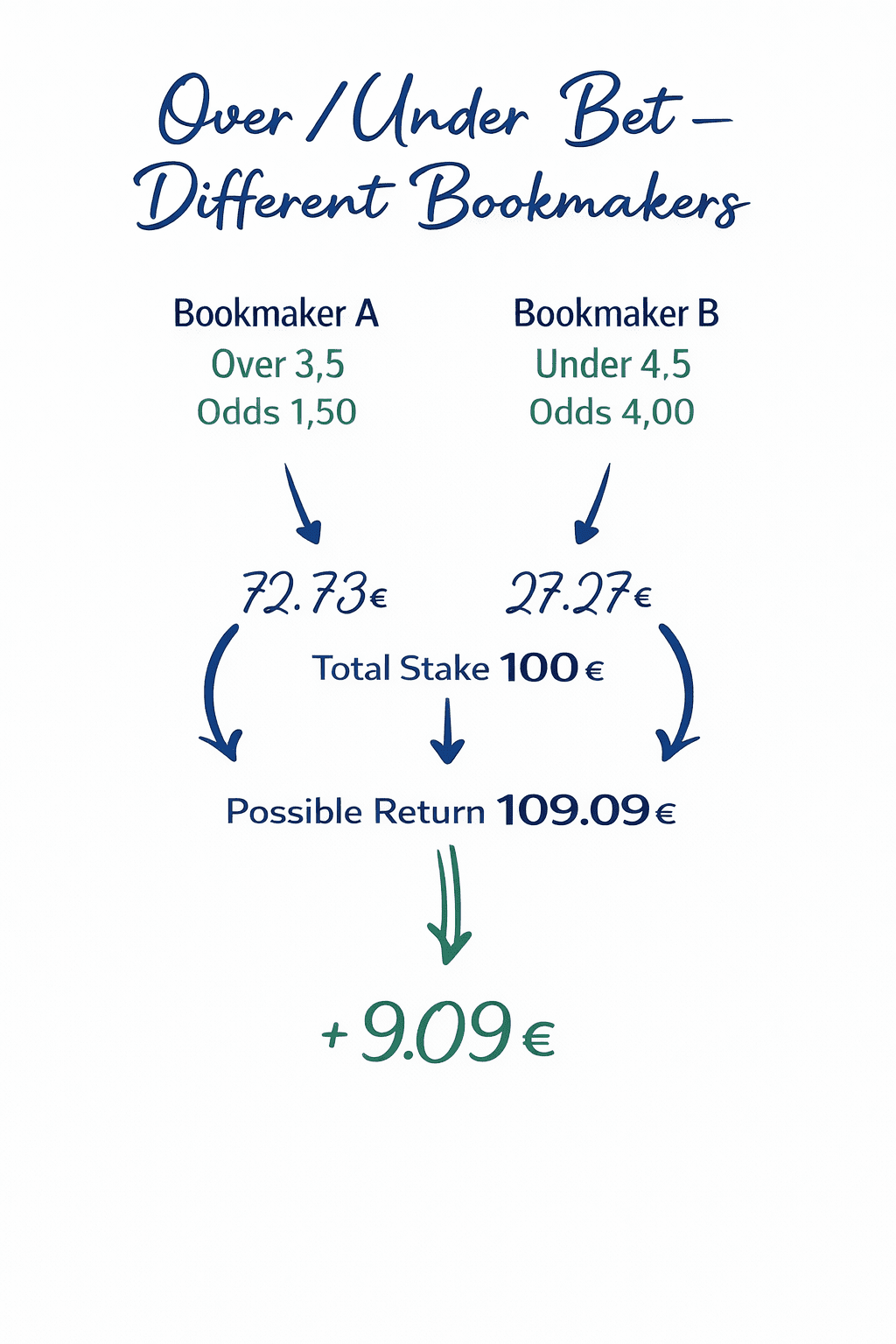
Surebet in a Two-Way Market
In a two-outcome market, it may be possible to distribute a total stake of €100 across two bookmakers in such a way that a guaranteed net profit of €9.09 is secured — regardless of how the match ends.
Arbitrage opportunities can also arise in three-way markets. However, the achievable profit margin is usually even smaller. In a typical configuration, a total stake of €100 might generate a guaranteed net profit of only €2.64, no matter which outcome occurs.
Example: Surebet in a Three-Way Market
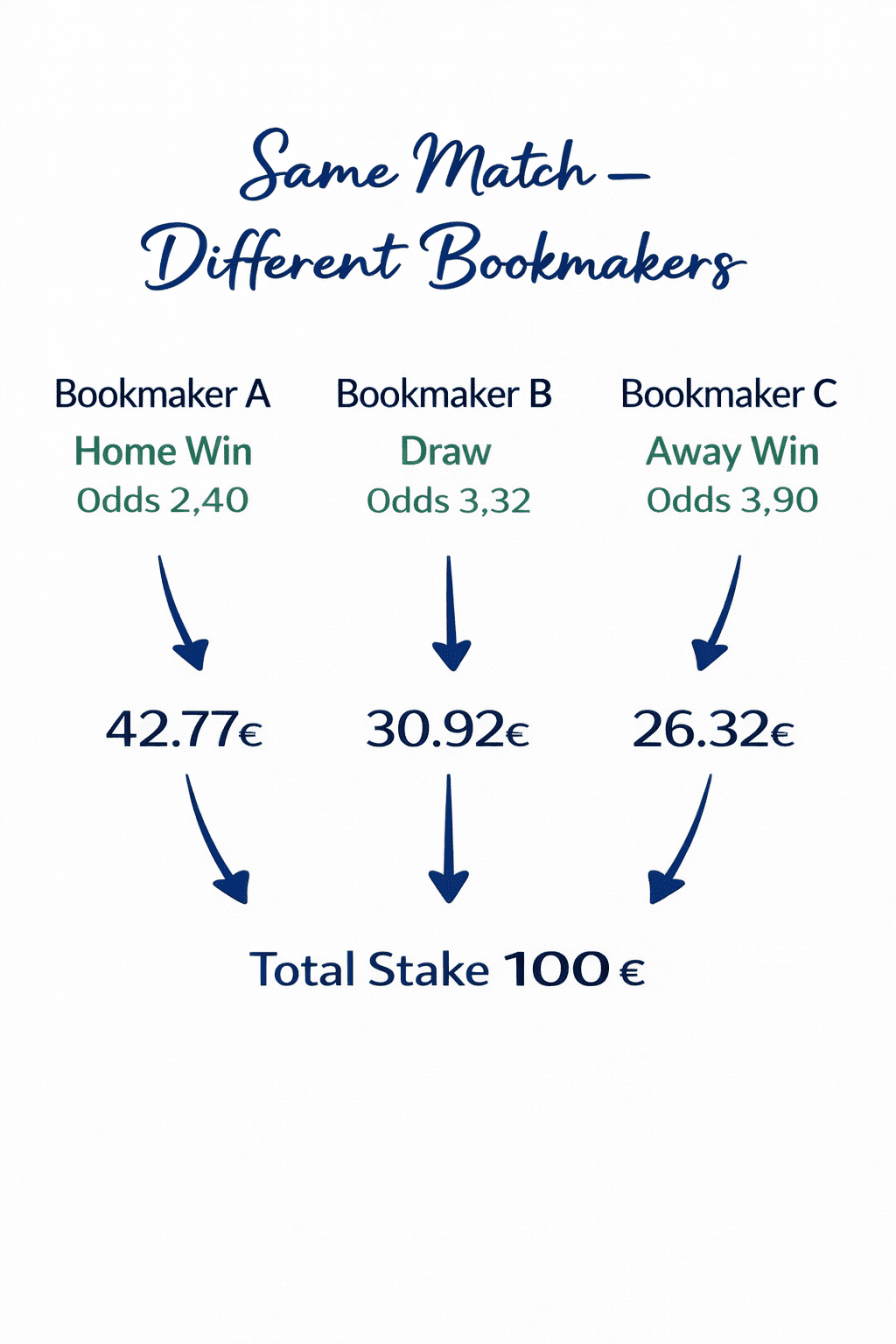
Surebet in a Three-Way Market
Arbitrage opportunities can also arise in three-way markets. However, the achievable profit margin is usually even smaller. In a typical configuration, a total stake of €100 might generate a guaranteed net profit of only €2.64, no matter which outcome occurs.
These examples highlight an important practical aspect of surebet betting: margins are often relatively low. To generate a net profit of €264 in the second scenario, a bettor would need to deploy a total stake of €10,000. In reality, placing such large stakes is not always possible, as many bookmakers apply limits on maximum stakes or potential winnings for specific markets.
How Reliable Are Sports Betting Tips — And Can You Trust Tipsters?
Analysing matches yourself is one approach — following tipsters is another. Across the internet, including on our own platform, you will find a constant stream of sports betting tips, particularly during major tournaments such as the UEFA European Championship or the FIFA World Cup. Most tips come with written reasoning and often link to bookmakers offering competitive odds. But how much weight should you give these recommendations?
In reality, no betting tip can ever be considered completely reliable — residual risk is an inherent part of sports betting. Even the best tipster platforms produce a mix of winning and losing selections over time. That said, high-quality betting tips can still serve a valuable purpose: they provide analytical inspiration, highlight markets you may not have considered, and offer alternative perspectives on a match.
Ultimately, every bettor must evaluate whether the reasoning behind a tip is logical, data-driven, and aligned with their own strategy. Blindly following tips without understanding the rationale is unlikely to produce long-term results. Sustainable profitability in sports betting requires independent thinking, disciplined bankroll management, and a structured analytical approach.
This is why developing your own betting strategy is essential. Successful bettors track their results systematically, identify where their true edge lies, and gradually adjust their stake sizes as their bankroll grows. Over time, this data-driven process enables bettors to build a genuine, repeatable edge against the betting market — rather than relying on luck or short-term variance.
Modern betting tools can significantly accelerate this journey. Platforms like Overlyzer provide real-time football statistics, pressure metrics, and advanced filtering options that help bettors identify high-probability situations before odds move. Instead of relying purely on intuition, Overlyzer enables you to validate betting decisions using objective match data and structured analysis.
https://www.youtube.com/watch?v=W4EYkAP-N8U
In the tutorial, a professional bettor demonstrates how to use Overlyzer to identify First Half Goal betting opportunities using live match data. You will learn how to apply FHG filters, interpret pressure graphs, and recognise early goal potential before bookmakers adjust their prices — offering a practical introduction to data-driven sports betting strategy.
The approach demonstrated in the video above serves as a practical blueprint for your own betting analysis. Observing how experienced bettors use Overlyzer to filter matches, interpret pressure data, and identify early opportunities is one of the fastest ways to shorten your learning curve and start applying data-driven thinking to your own selections.
Over time, however, the goal should be to develop a personalised betting strategy – one that fits your preferred markets, risk tolerance, and analytical approach. No two successful bettors operate identically, and the most durable edge is always one you have built and tested yourself.
Overlyzer is continuously evolving, with new features, expanded pre-match statistics, and enhanced live data tools being added regularly to support deeper and more accurate match analysis. In today's highly competitive betting landscape, bettors who combine analytical discipline with the right data tools hold a measurable advantage. Making full use of available statistics, pressure metrics, and filtering technology is no longer optional – it is essential for anyone serious about building a sustainable edge over the bookmakers.
What Is a Value Bet in Sports Betting?
A value bet is one of the most important concepts in sports betting — and one you will encounter repeatedly if you approach wagering seriously. In simple terms, a value bet occurs when the true probability of an outcome is higher than the probability implied by the bookmaker’s odds. When this condition is met, the bet has positive expected value (EV), meaning it is mathematically profitable over a large sample of wagers.
Identifying betting value requires two key inputs: your own probability estimate for the outcome and the decimal odds offered by the bookmaker. The core calculation is based on the following formula:
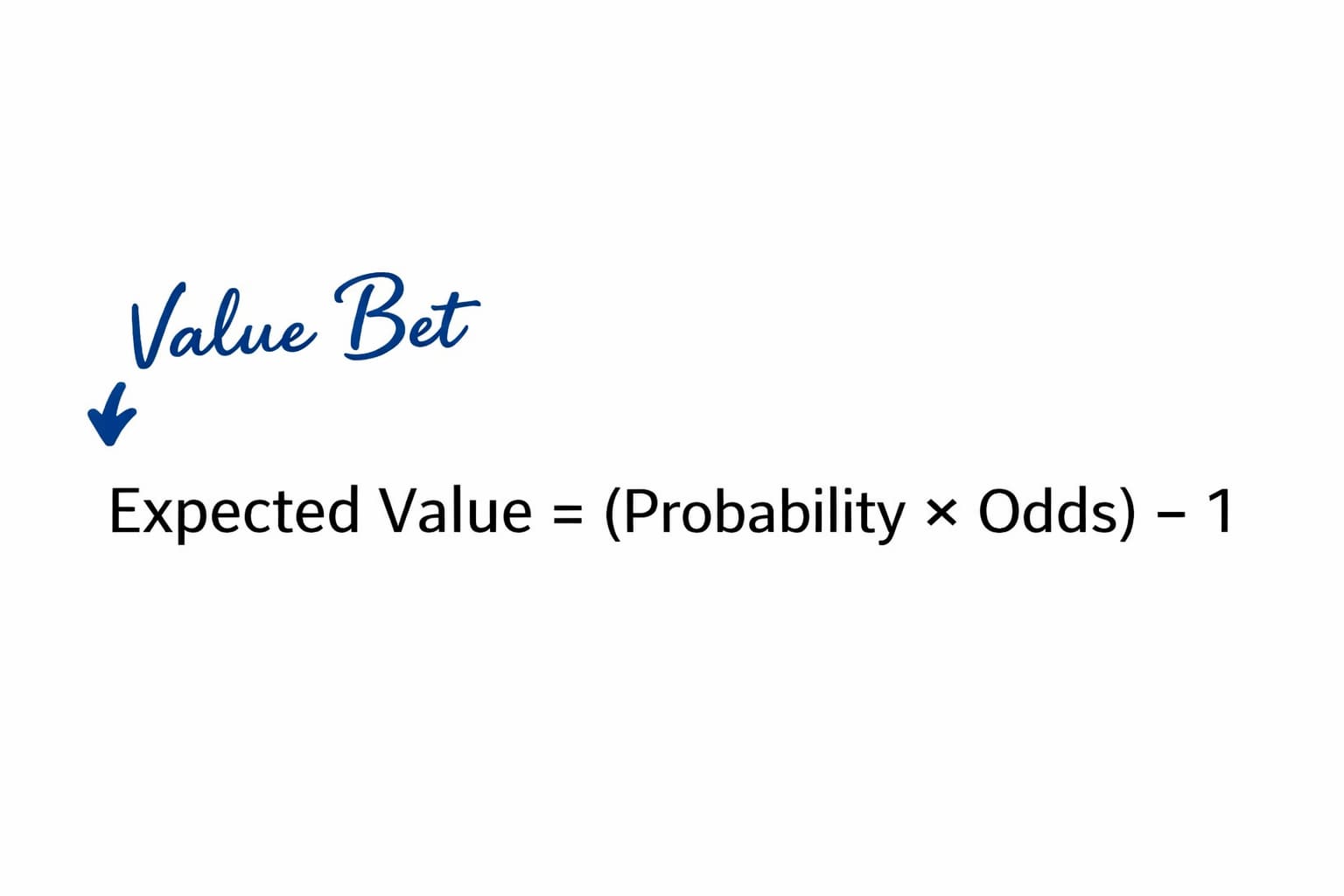
Value Bet Formula
A positive result indicates a value bet. A negative result means the bookmaker’s odds do not offer sufficient value relative to your probability estimate.
Value Bet Example — How to Calculate Betting Value in Practice:
Consider a hypothetical three-way market between Arsenal and Paris Saint-Germain. After your pre-match analysis, you estimate the following probabilities and compare them with the implied probability contained in the bookmaker´s odds:
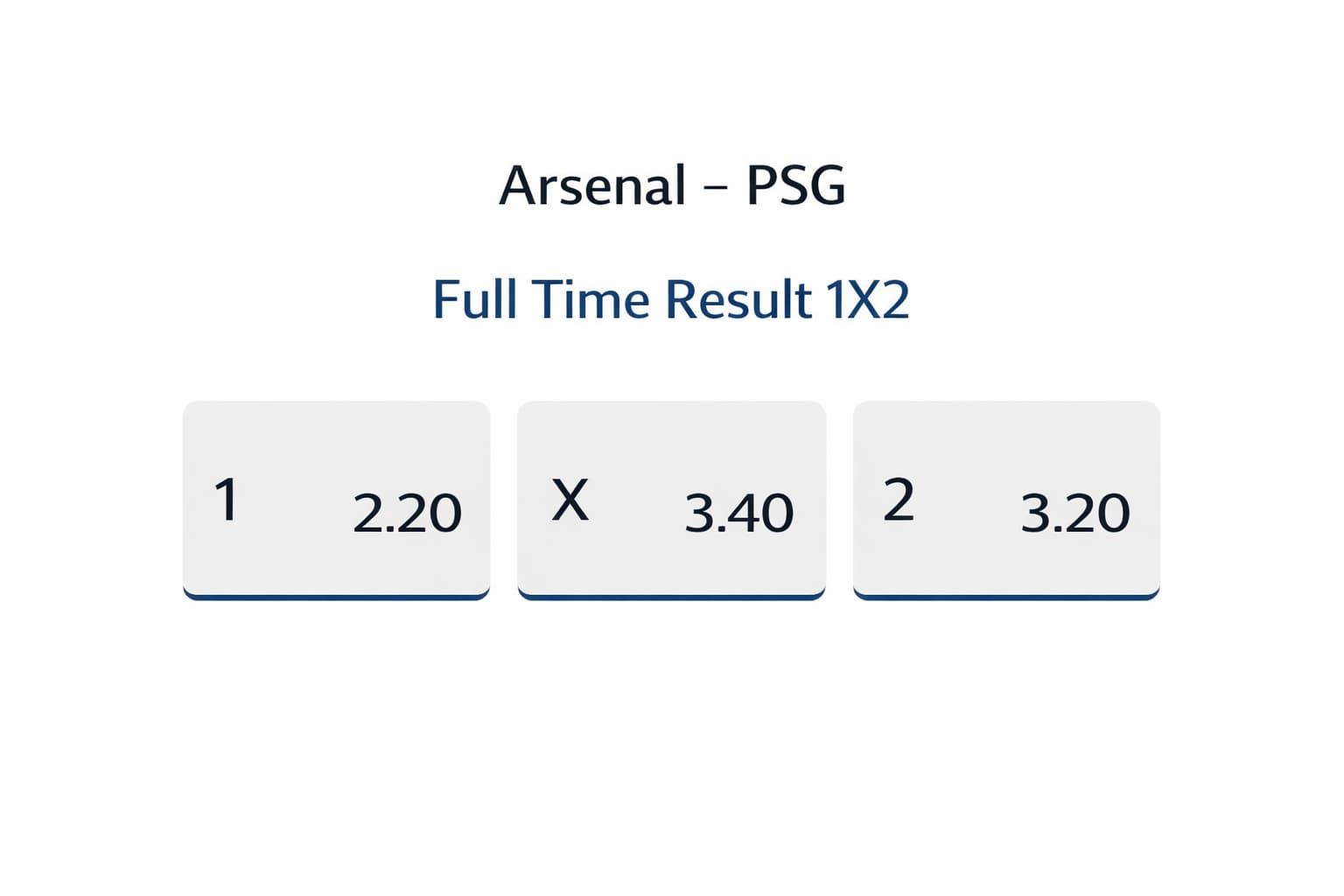
3-Way Bet
We now evaluate the possible match outcomes. In this example, we estimate a 50% probability of an Arsenal win, a 30% probability of a PSG win, and a 20% probability of a draw.
Next, we insert these probabilities into the value formula:
Arsenal Win
Value = (0.50 × 2.20) – 1
Value = 0.10
Draw
Value = (0.20 × 3.40) – 1
Value = –0.32
PSG Win
Value = (0.30 × 3.20) – 1
Value = –0.04
If we take your estimated probabilities as the benchmark, a bet on Arsenal would clearly qualify as a value bet in this scenario. The calculated value for the Arsenal selection is the only one in positive territory. The value of the PSG bet is close to zero, meaning it can be considered relatively neutral. The draw, which we assessed as the least likely outcome at 20%, produces a clearly negative value and therefore does not represent a bet with meaningful value.
All bets that produce a negative result when applying this formula are not value bets. Selections with a positive value, on the other hand, qualify as value bets. The higher the calculated value, the greater the theoretical advantage of the odds relative to your estimated probability.
Is Value Betting Subjective?
A value bet is ultimately grounded in probability estimates — and these always involve a degree of subjectivity. Even experienced bettors can reach different conclusions when analysing the same match. While statistical models and analytical platforms can provide data-driven probability forecasts, no model can eliminate uncertainty entirely. Each bettor must decide how much weight to assign to external predictions versus their own judgement — and how to integrate both into a consistent betting strategy.
The value formula also highlights that bookmaker odds are just as decisive as probability estimates when determining whether a bet represents genuine value. Even small differences in available prices — often identified through systematic odds comparison or line shopping — can significantly change the expected value of a wager. Comparing odds across multiple bookmakers is therefore a core habit among professional sports bettors.
If you find odds of 2.35 instead of 2.20 for an Arsenal win, the calculation changes as follows:
Arsenal win
Value = (0.50 × 2.35) – 1
Value = 0.175
With these higher odds, the calculated value of your bet increases by 7.5%. This interaction between your probability estimate — which typically remains unchanged — and the possibility of securing a better price from another bookmaker is crucial to monitor closely. Even relatively small improvements in odds can have a meaningful impact on the long-term profitability of a value betting strategy.
Your probability estimate can and should evolve as your pre-match analysis deepens. An initial assessment may shift significantly once you examine key variables such as confirmed team news, injury and suspension lists, recent form, head-to-head records, tactical match-ups, or fixture congestion. In some cases, a single piece of late information – such as a key player being ruled out – can materially change the expected outcome of a match. Continuously refining your probability estimates as new information becomes available is not a sign of uncertainty; it is a hallmark of disciplined, structured value betting."
How to Handle Losing Streaks in Sports Betting
Consistent winning in sports betting is impossible. Losing streaks are inevitable, and difficult runs can sometimes last far longer than expected — even for experienced bettors with a genuine edge. Anyone who has wagered seriously over an extended period knows how psychologically challenging it can be when nothing seems to work for weeks or even months. Navigating these phases with discipline, structure, and a clear head is one of the defining characteristics of a long-term successful bettor.
If you are losing a significant proportion of your bets over a prolonged period and your bankroll is shrinking noticeably, there are usually multiple contributing factors. Variance and bad luck may play a role — but they are rarely the only explanation. Rather than reacting emotionally, use difficult periods as a structured opportunity to audit your betting process. Ask yourself:
- Am I maintaining the same level of staking discipline as during better periods?
- Am I identifying genuine value bets — or simply backing likely outcomes?
- Has the depth or quality of my pre-match analysis declined?
- Am I betting too frequently, or on markets I do not understand well enough?
- Am I overexposing my bankroll on individual wagers?
- Am I consistently applying my bankroll management strategy?
In most cases, bettors experiencing a prolonged losing run will recognise at least some of these issues in their own behaviour. Professional sports betting is fundamentally about organisation, structure, and discipline — qualities that must be maintained during winning phases and reinforced even more rigorously during downturns. Losing streaks are not only inevitable; they are often the moments that lead to the most valuable improvements in a bettor’s process, mindset, and long-term consistency.
What Should You Do During a Losing Streak in Sports Betting?
A structured review of your recent betting activity is the essential first step. If you track your bets systematically – ideally in a dedicated betting log – go back and analyse your last 20 to 50 wagers. Look for patterns: have your stake sizes crept up? Has your pre-match analysis become less thorough? Have you drifted away from value-based selection criteria? Be honest about whether you have deviated from your original strategy or abandoned core principles such as bankroll discipline and objective match assessment.
Taking a temporary break is often the most productive step you can take. Betting opportunities are constant – there will always be more matches, markets, and competitions. Stepping away for a short period allows you to decompress, reduce emotional pressure, and return with a clearer, more objective mindset. Just as elite athletes build recovery phases into their training, experienced bettors recognise that mental reset periods are a legitimate and valuable part of a sustainable long-term strategy.
Accepting past results is equally essential. Losses cannot be recovered by increasing stake sizes or placing impulsive bets in an attempt to win everything back quickly. Loss chasing is one of the most destructive patterns in sports betting – it accelerates bankroll depletion and systematically undermines even well-constructed strategies. The correct response to a losing run is never aggression, but analysis: understand what went wrong, refine your process, and rebuild confidence through disciplined, structured execution.
Above all, never bet with money you cannot afford to lose. This principle is especially critical during the early stages of developing a betting strategy, when discipline is still being established and the risk of significant setbacks is highest.
Reaching a low point – or losing an entire bankroll – is a risk every bettor must consciously acknowledge. If this happens, the correct response is not desperation or impulsive action, but a calm, structured reassessment: stabilise emotionally, review what went wrong, and only return to betting once you have a clear, sustainable plan in place.
Betting out of frustration or stubbornness will not restore your bankroll. It will create compounding financial and psychological pressure that makes every subsequent decision harder. Long-term success in sports betting is built on clarity, process, and discipline – not on attempts to force results.
How to Stay Disciplined During Winning Streaks in Sports Betting"
Handling success in sports betting demands just as much discipline as navigating losing runs – only the emotional challenge is different. When results are consistently positive and bets appear to win effortlessly, many bettors fall into overconfidence bias: they increase stake sizes, bet more frequently, or take on markets they would normally avoid – all without objective justification. A growing bankroll is motivating, but it can also create a false sense of certainty that leads to avoidable mistakes.
Even during successful periods, a structured and self-critical approach remains essential. Continue reviewing your selections, auditing your staking discipline, and evaluating whether your decisions are genuinely process-driven. Short-term success can occur even when discipline has slipped – but results built on favourable variance rather than sound decision-making are not repeatable, and the correction is often sharp when it comes.
The principle of sticking to your plan is most tested – and most important – during winning runs. Favourable outcomes do not mean underlying risks have diminished. In practice, the most significant drawdowns often follow periods of excessive confidence, when bettors begin to deviate from their process, overtrade, or increase exposure beyond their bankroll management rules. Maintaining consistent betting frequency, analytical standards, and stake discipline during good runs is what separates bettors who sustain performance from those who give back their gains.
Whether you are winning or losing, the fundamentals never change: invest time in thorough pre-match analysis, maintain staking discipline, and continuously evaluate and refine your approach. Long-term success in sports betting is not built on hot streaks or fortunate runs – it is built on consistency, process, and the ability to perform to the same standard regardless of recent results."
What Happens to a Sports Bet If a Match Is Abandoned?
Match abandonments are relatively rare, but they do occur across all levels of sport. If you have placed a bet on a fixture that is subsequently interrupted, postponed, or cancelled before completion, the key question is whether your wager will be voided and your stake refunded – or whether the bet remains active until the match is replayed or completed. The answer depends on the specific rules of your bookmaker and the circumstances of the abandonment.
Common Reasons Why Matches Are Abandoned, Postponed, or Cancelled
Football matches and sporting events in general can be cancelled, postponed, or abandoned for a wide range of reasons. The most common causes include:
- Severe weather conditions rendering the pitch unplayable
- Poor visibility due to fog, heavy snow, or extreme weather
- Crowd disturbances or serious fan-related incidents
- Security concerns identified before or during the fixture
- National or international tragedies – entire matchdays have been postponed following events such as the Chapecoense air disaster, major terrorist attacks, or natural catastrophes
- Serious confrontations between players, staff, or match officials
- Irreparable floodlight or stadium infrastructure failures
- A team being reduced below the minimum number of players required to continue
In exceptional circumstances, entire competitions can be suspended. During 2020, professional football leagues worldwide were halted due to the COVID-19 pandemic, and UEFA EURO 2020 was postponed by a full year – creating widespread uncertainty around open bets across all major bookmakers.
How Are Abandoned Match Bets Settled? Bookmaker Rules Explained
If a match you have bet on is abandoned, postponed, or cancelled, the first step is always to check your bookmaker’s terms and conditions. These rules define precisely how unsettled bets are handled in each scenario. While certain industry-wide conventions exist, the exact settlement of your wager ultimately depends on the specific rules of your operator — which can vary significantly between platforms.
In most cases, abandoned or cancelled matches are settled at odds of 1.00 — meaning the stake is effectively refunded. If the selection formed part of an accumulator, the abandoned match is removed from the bet slip and the remaining selections continue as normal. However, bettors should note that this removal also reduces the overall accumulator odds. For example, if a cancelled leg originally carried odds of 1.50 and the full accumulator was priced at 5.00, the revised odds would drop to approximately 3.33 (5.00 ÷ 1.50 = 3.33) — a meaningful reduction in potential return.
Many bookmakers also apply a time limit rule: if the abandoned match is resumed or replayed within a predefined window — commonly 48 or 72 hours after the original kick-off — the original bet typically remains valid and will be settled once the fixture is completed. If the event does not take place within that timeframe, the bet is usually voided and the stake returned. The exact window varies between operators, so checking the specific terms in advance is always advisable.
Abandoned match rules are among the most frequently searched topics in sports betting, and most bookmakers address them clearly in their terms and conditions or dedicated FAQ sections. If you cannot locate the relevant information, contacting customer support directly is the most reliable option — operators can confirm exactly how your specific bet will be handled, quickly and without ambiguity
Cash Out in Sports Betting - How It Works and When to Use It
A football match is only officially over when the referee blows the final whistle – at least from a sporting perspective. In sports betting, however, the cash out feature has fundamentally changed this dynamic. Available at most major bookmakers, cash out allows bettors to settle a wager before the event has concluded – locking in a profit or limiting a potential loss while the match is still in progress. By effectively selling the bet back to the operator at a price reflecting the current probability of the outcome, bettors gain real-time flexibility and dynamic control over their positions. Many bookmakers also offer a partial cash out option, allowing bettors to withdraw a portion of the stake while keeping the remainder active.
Understanding how cash out works in practice – and developing a structured approach to using it – can make a meaningful difference to long-term betting results. Below, we examine the mechanics of cash out, its advantages and limitations, and whether it can form part of a disciplined betting strategy.
The cash out amount offered by a bookmaker is determined by how the probability of your bet winning has shifted since placement. If the likelihood of your predicted outcome has increased, the cash out value will typically exceed your original stake – allowing you to secure a guaranteed profit before the final whistle. If the match has developed unfavourably, the offered amount may fall below your initial stake, giving you the option to minimise losses.
One principle always applies: early settlement almost always returns less than the full potential payout at the original odds. This difference represents the bookmaker's built-in margin for providing the cash out service. The exact value of any cash out decision depends entirely on the live status of the wager and the operator's real-time pricing model.
To illustrate: if you placed a bet on a Bayern Munich home win in the Bundesliga and they lead 2–0 shortly before full time, the bookmaker will offer a cash out amount close to the full potential return – reflecting the now very high probability of the outcome. Conversely, if Bayern trail 0–1 at half time, the cash out value will have dropped significantly below your original stake. In that scenario, cashing out allows you to recover a portion of your stake rather than risking a total loss – a decision that depends entirely on your assessment of how the match is likely to develop."
Advantages of Using Cash Out in Sports Betting
The availability of a cash out feature is never a disadvantage in itself – it simply represents an additional tool that bettors can choose to use or ignore. However, as we will examine later, applying cash out without a clear strategic framework can undermine long-term profitability. Used correctly, it is a valuable instrument for active bankroll management.
The primary advantage of cash out is risk management. Rather than passively waiting for a final result, bettors can actively manage their position in real time – settling the bet early at a price reflecting the current match situation. This transforms sports betting from a static activity into a dynamic, in-play decision-making process, giving bettors meaningful control over their exposure at any point during the event.
Cash out is particularly valuable when the dynamics of a match shift in unexpected ways. Consider a scenario where you have backed Borussia Dortmund to win at home against Bayer Leverkusen, and Dortmund takes the lead in the first half. Shortly afterwards, a key player is injured, a central defender picks up a second yellow card risk, and Leverkusen visibly increase their attacking pressure after the break. In this situation, accepting an early cash out – even if it means forfeiting part of the potential return – is a rational, process-driven decision that protects your betting capital. Alternatively, if your bookmaker offers partial cash out, you may choose to secure a portion of your winnings while leaving the remainder at risk – a balanced approach that maintains some upside while reducing overall exposure.
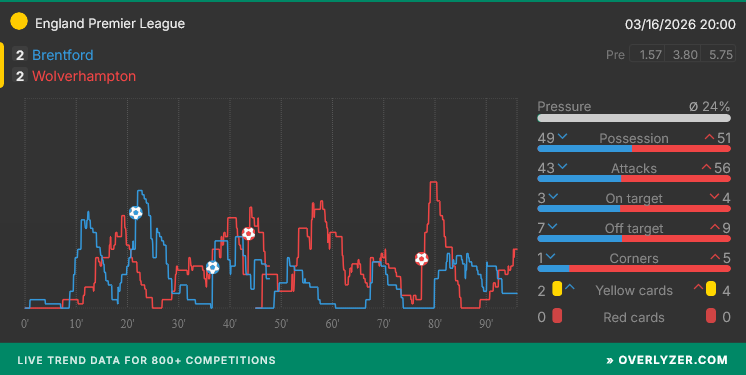
The blue line always represents the pressure exerted by the home team — in this case Brentford. The pressure applied by Wolverhampton Wanderers is shown by the red line.
If you had placed a bet on a Brentford win in this match, it could have been a sensible decision to use the cash out option during the second half. The pressure graph clearly shows that Wolverhampton’s attacking momentum increased significantly from around the 55th minute onwards, indicating that the away side was growing closer to scoring. In such a scenario, activating the cash out function between the 55th and 75th minute could have helped protect your bankroll and avoid a potentially losing position.
» Register at Bet365 to use the best cashout system in the industry
Form Trends and Winning Streaks in Sports Betting
Form indicators and streak-based statistics – such as winning runs, matches with goals scored, clean sheets, or consistent Over 2.5 outcomes – are among the most widely used tools in sports betting analysis. However, they should be interpreted as contextual signals rather than standalone decision-making criteria. Their primary value lies in identifying so-called hot phases or momentum patterns, which must always be validated against underlying performance data before being used as a basis for wagering.
The critical question when evaluating any streak is whether it reflects genuine performance dominance – evidenced by consistent high-quality chance creation, sustained shot volume, and recurring pressure phases of the kind visible in Overlyzer's live pressure charts – or whether it is primarily the product of efficiency outliers, such as an unusually high shot conversion rate that is unlikely to be maintained over a larger sample.
In betting analysis, regression to the mean refers to the tendency of results to move back towards a team's true underlying performance level after periods of over- or underperformance. One of the most practical tools for identifying this is the Expected Goals (xG) model. By comparing actual goals scored and conceded with the corresponding xG and xG Against values across recent matches, bettors can assess whether results are statistically supported or driven by temporary variance. These deviations should always be contextualised within a team's broader seasonal performance profile to avoid overreacting to short-term fluctuations.
A structured form assessment should combine two complementary layers of analysis: first, visible outcomes and streaks – consecutive wins, goal-scoring runs, clean sheets, or Over 2.5 trends; and second, underlying performance metrics that indicate whether those results are statistically justified – including xG differential, shots on target ratio, and sustained pressure phases identified through Overlyzer's analytical tools.
The decisive factor is always the relationship between results and performance data. When both align, a team's form is likely stable and sustainable. When they diverge significantly, the streak is more likely driven by temporary efficiency or variance – and should be treated with corresponding caution in betting analysis.
Consider a practical example: Team A has scored 18 goals across its last ten matches despite generating only 12.0 xG – and has conceded 14 goals from chances worth just 10.0 xG Against. In both attacking and defensive terms, outcomes deviate substantially from underlying chance quality. This does not guarantee an immediate trend reversal, but it does indicate that recent results should be interpreted with caution. For betting purposes, these ten matches must be placed in the context of the team's full-season performance profile – isolated form windows, however impressive, rarely tell the complete story.
We continuously expand Overlyzer's Pre-Match tool to make identifying form trends and performance streaks even more precise. Across all major and many minor leagues, bettors can access Expected Goals data and a growing range of advanced statistics, allowing them to evaluate whether a team's recent results are supported by underlying performance metrics. This makes it significantly easier to distinguish between sustainable form driven by consistent chance creation and pressure phases – and short-term streaks that are primarily the result of efficiency or variance.
Expected Goals (xG) Explained – How to Use xG in Sports Betting Analysis
Football is a low-scoring sport where individual goals are statistically rare events – yet they frequently determine match outcomes. This creates substantial short-term variance, where final results can diverge sharply from the actual balance of play. Expected Goals (xG) were developed to address this problem by shifting the analytical focus from final scorelines to the quality of chances created – providing a more stable and reliable measure of team performance.
Rather than relying solely on past results, bettors can use xG to assess whether a team is consistently generating high-quality scoring opportunities – or whether recent outcomes were driven by finishing efficiency, favourable variance, or isolated moments. The widespread adoption of xG models across professional clubs, broadcast analysis, and the betting industry reflects their recognised value as an objective, repeatable performance indicator.
What Are Expected Goals (xG)?
Expected Goals assign a probability value between 0 and 1 to every shot. A chance with an xG value of 0.10, for example, means that historically comparable attempts have resulted in a goal approximately 10% of the time. By aggregating the xG values of all shots for both teams, the model produces an estimate of how many goals would typically be expected given the chances created – independent of whether those chances were converted or missed.
For betting purposes, xG should not be treated as a prediction tool for exact scorelines. It is best understood as a measure of chance quality and a more reliable indicator of underlying team performance than raw goal tallies or shot counts alone.
How Are Expected Goals Calculated? The xG Model Explained
The underlying principle is straightforward: large historical shot datasets are analysed to determine how frequently attempts from comparable situations result in goals. Modern data providers train statistical and machine learning models – ranging from logistic regression to more advanced algorithms – on extensive shot databases. Key input variables typically include shot location (distance and angle to goal), body part used, assist type, match situation (such as open play, transitions, or set pieces), and contextual factors like defensive pressure and goalkeeper positioning. The exact model structure varies between providers depending on data depth and methodology.
For example, penalties are typically assigned a fixed xG value across most data providers, reflecting their historically stable conversion rate. Depending on the model and underlying dataset, this value usually falls within a narrow range of approximately 0.76 to 0.79 xG. The key differences between xG models therefore emerge primarily in open-play situations. Some providers use relatively streamlined models with a limited set of shot descriptors, while others — such as the Opta models described by Stats Perform — incorporate a broader range of in-play contextual variables, including defensive pressure, goalkeeper positioning, assist type, and phase of play. These additional inputs allow for more granular probability estimates without contradicting the use of fixed baseline values for standardised situations like penalties.
Expected Goals (xG) Betting Strategy – How to Use xG in Pre-Match Analysis
The core principle of any xG-based betting strategy is to identify discrepancies between actual results, bookmaker odds, and a team's true underlying performance as measured by Expected Goals. By focusing on chance quality rather than scorelines, bettors can detect mispriced markets before odds fully adjust – creating a structural pre-match edge that is grounded in objective data rather than recent results alone.
Using xG to Identify Overperforming and Underperforming Teams
If a team consistently scores more goals than its xG figures suggest, this may reflect genuine attacking quality or elite finishing – but in many cases it represents short-term xG overperformance that tends to revert towards the mean over time. Analytical research consistently shows that sustained gaps between goals scored and expected goals are difficult to maintain across a full season. Conversely, teams generating high-quality chances but converting relatively few of them may simply be experiencing finishing variance or unfavourable luck – and represent a potential value opportunity as results catch up with underlying performance.
From a betting perspective, these deviations create exploitable value opportunities – particularly when bookmaker odds are still heavily influenced by recent results while underlying xG data already signals a different performance reality. Identifying and acting on these divergences early, before the market corrects, is one of the most reliable structural edges available in pre-match sports betting.
Using xG for Over/Under and Both Teams To Score (BTTS) Betting Markets
Expected Goals data is equally valuable when assessing totals markets such as Over/Under goals and Both Teams To Score (BTTS). Rather than relying on historical scorelines alone, bettors can estimate the likely goal environment of a match by analysing the combined xG output of both teams – often referred to as total match xG. This approach produces a more accurate projection of whether a fixture is likely to be open and high-scoring or compact and low-scoring, helping to refine betting decisions in goal-related markets well beyond what raw results data can offer."
Live Betting with xG – How to Use Real-Time Expected Goals and Pressure Data"
In live betting, Expected Goals become particularly powerful because they allow you to evaluate match dynamics based on the actual quality of scoring chances – not surface-level indicators such as possession percentage or total shot count. This provides a significantly more accurate picture of which team is genuinely creating dangerous situations and which is merely controlling the ball without generating real threat.
Consider a match still level at 0–0 at half-time where one team has already accumulated 1.8 xG. The goalless scoreline in this case likely reflects finishing variance or an exceptional goalkeeping performance rather than a genuine balance of play. The underlying data suggests clear dominance – and a potentially mispriced live market. The inverse is equally instructive: a team leading 1–0 despite generating only 0.3 xG may be benefiting from a fortunate scoreline that does not reflect the actual run of play.
Expert Tip: Always combine xG data with the Overlyzer pressure chart when making live betting decisions. If a team's pressure level rises clearly in the chart while high xG values are simultaneously being recorded, the overall picture of dominance becomes significantly stronger. This convergence of indicators – sustained pressure combined with high chance quality – often signals a momentum shift and a genuine increase in goal probability, potentially representing a well-timed opportunity for an informed in-play betting decision.
Advanced Football Metrics in Sports Betting – How to Interpret Them Correctly
Advanced football metrics are frequently misunderstood or analysed in isolation in betting contexts. Their value does not lie in automatically generating value bets – it lies in helping bettors interpret match dynamics, tactical structures, and performance trends with greater precision. Used correctly, these indicators make it significantly easier to anticipate shifts in game flow and to evaluate markets such as Over/Under or Both Teams to Score with well-founded confidence.
Understanding and correctly interpreting advanced metrics provides critical insight into how teams actually play – beyond what results, standings, or basic statistics can reveal. Combined with live analytics tools such as Overlyzer, bettors can build a substantially more accurate picture of match dynamics and identify betting opportunities that less informed market participants are likely to miss.
Interpreting Possession Correctly – Control, Pressure, and Real Goal Threat
Possession statistics and pass counts describe playing style – not necessarily team quality or attacking effectiveness. Teams with high possession often control tempo and territorial positioning, but this does not automatically translate into genuine goal threat. Possession becomes analytically meaningful for betting purposes only when combined with progression – measurable through penetrative passes into dangerous zones, entries into the final third, or sustained attacking phases that generate real pressure. This is where the Overlyzer pressure chart adds particular value. A team showing high possession but limited pressure spikes in the chart is displaying what analysts refer to as sterile dominance – extensive ball circulation with little genuine scoring threat. Recognising this pattern is essential for avoiding misleading conclusions based on possession data alone.
In practical betting terms, high possession without corresponding pressure spikes generally argues against Over bets – particularly in first-half markets such as First Half Over 0.5 or First Half Over 1.5 goals. Matches dominated by sterile possession tend to develop slowly, remain compact, and produce fewer scoring opportunities than the possession figures might suggest.
Conversely, teams with lower possession but recurring pressure peaks can generate significant goal threat – particularly through rapid vertical transitions and counter-attacking play. In these scenarios, possession figures alone create a misleading picture of the match dynamic. Combining possession data with pressure chart analysis allows bettors to distinguish clearly between teams that merely control the ball and teams that consistently threaten to score – a distinction that can be decisive when evaluating Over/Under, BTTS, or next-goal markets
Shot Statistics in Betting Analysis – What They Reveal and How to Use Them
Shot statistics provide a closer approximation of goal outcomes than possession data – but they still require careful interpretation. Raw shot counts measure attacking volume, not chance quality. Shots on target represent a more meaningful indicator, as they imply at least a minimum level of genuine finishing threat and require active intervention from the goalkeeper or defence.
A more precise measure of chance quality is provided by Expected Goals (xG), which estimates the probability of each individual attempt resulting in a goal based on historical shot data. Shot conversion – the ratio of goals scored to total shots – adds a further layer by reflecting finishing efficiency. However, conversion rates are highly volatile over small sample sizes and should never be analysed in isolation. For betting purposes, the most reliable approach combines shot volume, shots on target, xG values, and conversion rates into a coherent picture of attacking effectiveness – rather than relying on any single metric alone.
Matches in which both teams regularly generate shots on target are generally more conducive to Over goals markets and Both Teams to Score scenarios. By contrast, high overall shot counts combined with a low proportion of on-target attempts typically indicate speculative long-range efforts, blocked shots, or poor final-third decision-making. These patterns can also increase the frequency of corner situations – making shot distribution data particularly relevant for bettors active in corner betting markets or set-piece-based wagering strategies.
Offside Statistics in Football Betting – What They Reveal About Tactics and Playing Style
Betting on the number of offsides is available at some bookmakers, but it remains a niche market not consistently offered across all competitions. The primary analytical value of offside statistics lies not in predicting exact counts, but in interpreting team tactics and playing style – particularly the use of high defensive lines, offside traps, and the attacking patterns of the opposing team.
Frequent offside situations typically arise from vertical attacking patterns – early forward passes, aggressive depth runs behind the defensive line, and a general emphasis on penetrating space quickly in transition. This indicates a direct offensive approach built around movement and risk-taking in possession. However, offside frequency is always co-determined by the opponent's defensive structure – particularly the height, coordination, and aggressiveness of their back line and whether they actively deploy an offside trap.
Teams that consistently generate high offside counts are typically attempting to penetrate compact defensive structures through proactive movement and forward runs. When both teams in a fixture show tendencies towards vertical play and high defensive lines, the resulting match dynamic often produces more open, transitional football – a pattern that can support Over goals markets and Both Teams to Score scenarios. Conversely, when a defensively disciplined team with a well-organised offside trap faces a direct opponent, offside data can help anticipate a more contained, lower-scoring encounter.
Blocked Shots in Betting Analysis – What They Reveal About Defensive Organisation
Blocked shots provide valuable insight into how consistently a team protects dangerous shooting zones and closes down space. They occur most frequently against opponents that defend deep and compact, deliberately forcing attackers into low-quality shooting positions. When a team applies sustained pressure but a large proportion of attempts end in blocks rather than shots on target, this strongly indicates that the defending side is effectively controlling attacking phases. In such scenarios, territorial dominance does not automatically translate into genuine goal threat – and early goal markets should be approached with caution until the pattern shifts.
Over larger sample sizes, these defensive tendencies become clearly identifiable in the data. Burnley FC under Sean Dyche represented a classic Premier League example across multiple seasons: defending in a deep block, conceding a relatively high shot volume but blocking an above-average proportion through disciplined compact positioning and organised penalty-area defending. Despite visible pressure from opponents, matches frequently remained low-scoring because the attempts conceded were rarely of high quality.
A more contemporary interpretation of a similar profile was visible at Brentford FC under Thomas Frank: frequent low-block defending, high shot volumes allowed, but a strong tendency to block attempts before they reached the goalkeeper – meaning that apparent attacking dominance from opponents did not reliably convert into clear-cut scoring chances. Both examples illustrate how blocked shot data can reveal defensive qualities that standard metrics such as shots conceded or xG Against may understate.
Teams with such defensive profiles make it systematically difficult for opponents to create high-quality opportunities, often resulting in balanced and low-scoring match states.
A combination of high shot volume conceded and a significant proportion of blocked attempts can therefore support Under bets or cautious handicap positions against favourites – even when those favourites appear superior in xG or possession metrics. The decisive factor is not how many shots a team concedes, but how effectively their defensive structure controls the location, angle, and pressure context of those attempts
High Roller Sports Betting – What It Means and How to Build Up to It
High rollers typically stake significantly more than the average bettor – but their decisions are rarely driven by intuition or impulse. Core characteristics include a strict separation between betting bankroll and personal finances, clearly defined staking limits per wager, and a consistent focus on expected value and closing line value rather than short-term outcomes.
Bankroll Management for High Stakes Bettors
A structured bankroll framework is the foundation of high-level betting. Serious high rollers typically risk only a small percentage of their total capital per wager – generally between 0.25% and 2%, with sustained exposure above this level considered aggressive. Many also maintain a separate reserve bankroll specifically designed to cushion extended downturns without forcing deviations from their strategic framework.
Equally important is rigorous bet tracking. Every wager should be logged in a dedicated betting record – including odds taken, closing line odds, market type, stake size, and outcome. Over time, this data allows bettors to identify genuine edges and weaknesses in their approach, measure whether they are consistently beating market pricing, and make evidence-based adjustments to their strategy.
How to Become a High Roller Bettor - A Structured Approach
Becoming a high roller requires more than capital. It demands a deep understanding of betting markets, probability estimation, and personal risk tolerance. Successful high-stakes bettors continuously review their decision-making process, challenge flawed assumptions, and refine both their analytical models and staking structures. With larger stakes, errors carry significantly higher costs – making honest self-assessment and disciplined process review essential habits.
Most professional bettors do not attempt to cover every available market. Instead, they specialise in specific leagues, competitions, or bet types – a practice known as market specialisation. This focused expertise sharpens pricing judgement, reduces errors caused by insufficient contextual knowledge, and allows bettors to identify mispriced odds with greater consistency.
A defining principle of high-level betting is that stake size is the consequence of a proven strategy – not its starting point. Long-term success requires developing a clear, repeatable betting logic and demonstrating over a sufficiently large sample that this approach consistently outperforms market pricing. Only once a strategy has proven robust do experienced bettors scale their stakes in a measured and controlled manner.
Modern analytical tools such as Overlyzer support this development process by highlighting match dynamics, pressure phases, and statistical patterns that allow bettors to test and refine structured strategies. Advanced filtering options make it possible to model different approaches, compare performance across time periods, and continuously optimise decision-making frameworks. The objective is never the outcome of a single bet – it is the construction of a system capable of delivering sustainable results across months and seasons.
Many high rollers active on Overlyzer today started with small stakes. Their progression followed a consistent pattern: systematic performance tracking, continuous strategy refinement, and disciplined use of filtering tools to test hypotheses under consistent conditions. Once a strategy proved robust over a meaningful sample, stake sizes were increased gradually and with full strategic justification.
https://www.youtube.com/watch?v=LljGhIIW7Fk
In the tutorial above, a professional bettor demonstrates how to use Overlyzer´s live filtering tools at half-time to identify matches with strong potential for at least two second-half goals – a practical walkthrough of how data-driven, high-stakes betting decisions are made in real time..
Choosing the Right Sportsbook as a High Roller – What to Look For
Sportsbook selection is a critical consideration for high-stakes bettors. Wagers should be placed exclusively with internationally established, fully licensed operators that offer high maximum betting limits, stable technical infrastructure, transparent settlement processes, and responsive customer support. Well-known examples include Bet365, Pinnacle – widely regarded as the most bettor-friendly bookmaker in terms of limits and margin – and a number of regulated European operators with strong reputations for handling larger transaction volumes.
High rollers should also be aware that accounts showing consistent profitability may be subject to stake restrictions or account limitations by some operators. This makes it advisable to maintain accounts at multiple bookmakers, allowing bettors to distribute volume, compare odds, and reduce dependence on any single platform.
Conclusion: Being a high roller does not simply mean betting big. It means transforming capital, knowledge, and discipline into a structured, repeatable system. Effective bankroll management, analytical decision-making, emotional control, and the targeted use of modern betting tools such as Overlyzer are not optional extras – they are the foundation of sustainable long-term success at any stake level