
Football Betting Tips - Understanding Betting with Overlyzer
On this page
Football Betting Tips – Learn How to Bet Smarter with Overlyzer
Not all bets are the same — and in online sports betting, that has never been more true. Betting on match results or picking the outright winner remains one of the most popular betting markets.
Betting on match outcomes has existed since ancient times, but with the rise of the internet, the range of available online betting markets has expanded significantly.
We provide a comprehensive sports betting guide covering all major betting markets, their meaning, and the underlying mechanics and strategies behind each one.
1X2 Betting Explained: Your Guide to the Full-Time Result
The 1X2 bet is the classic three-way wager used to predict the full-time result. While we will explore numerous other betting markets later, we’ll start by focusing on the fundamentals of 1X2 betting.
What is 1X2 Betting?
This market is all about predicting the final outcome of a fixture. There are three potential results you can back:
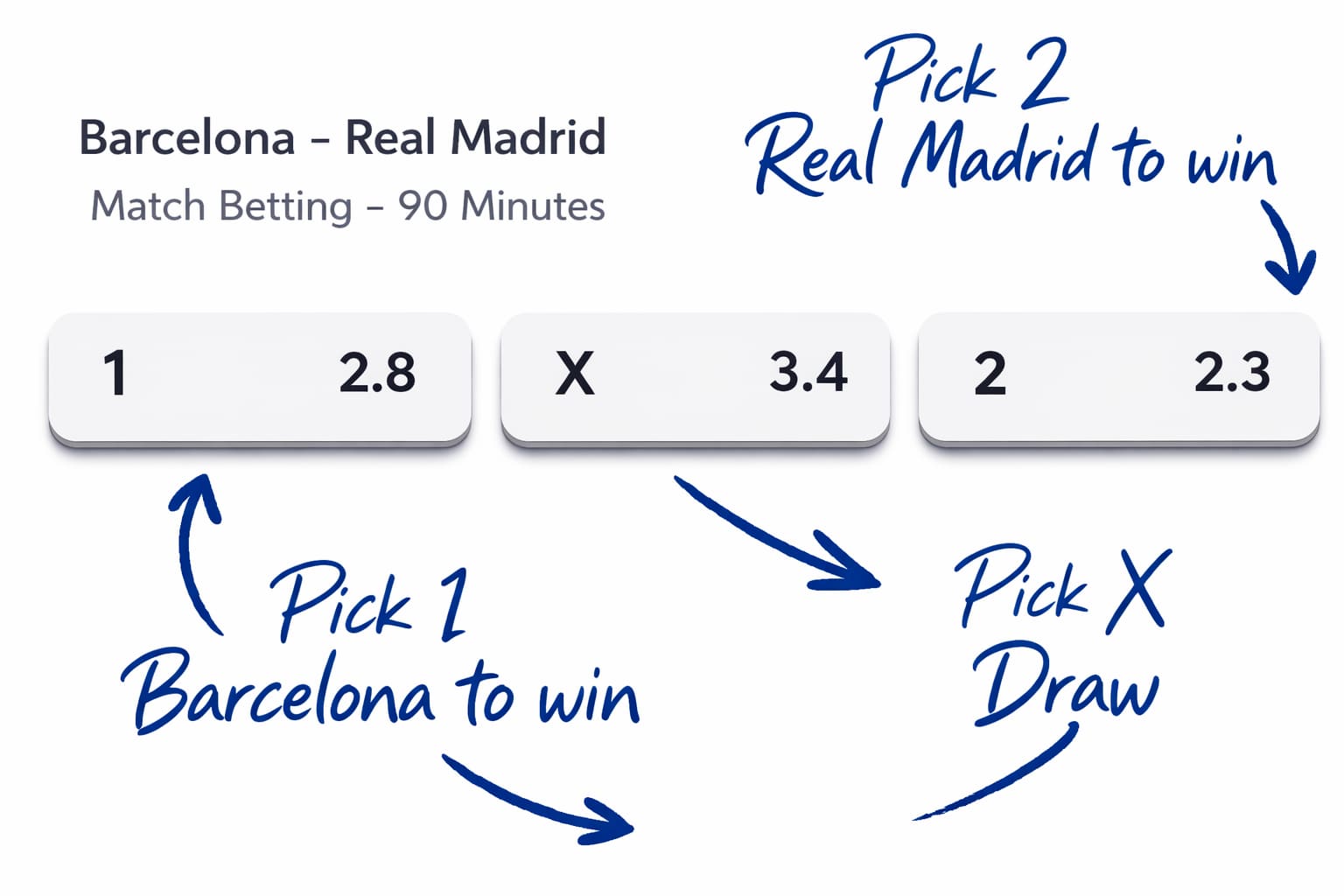
The 1X2 Bet
- 1 stands for a home win
- X stands for a draw, meaning neither team wins.
- 2 stands for an away win.
The odds for each selection in the 1X2 market vary, reflecting the relative strength and perceived probability of each side.
The Single Bet
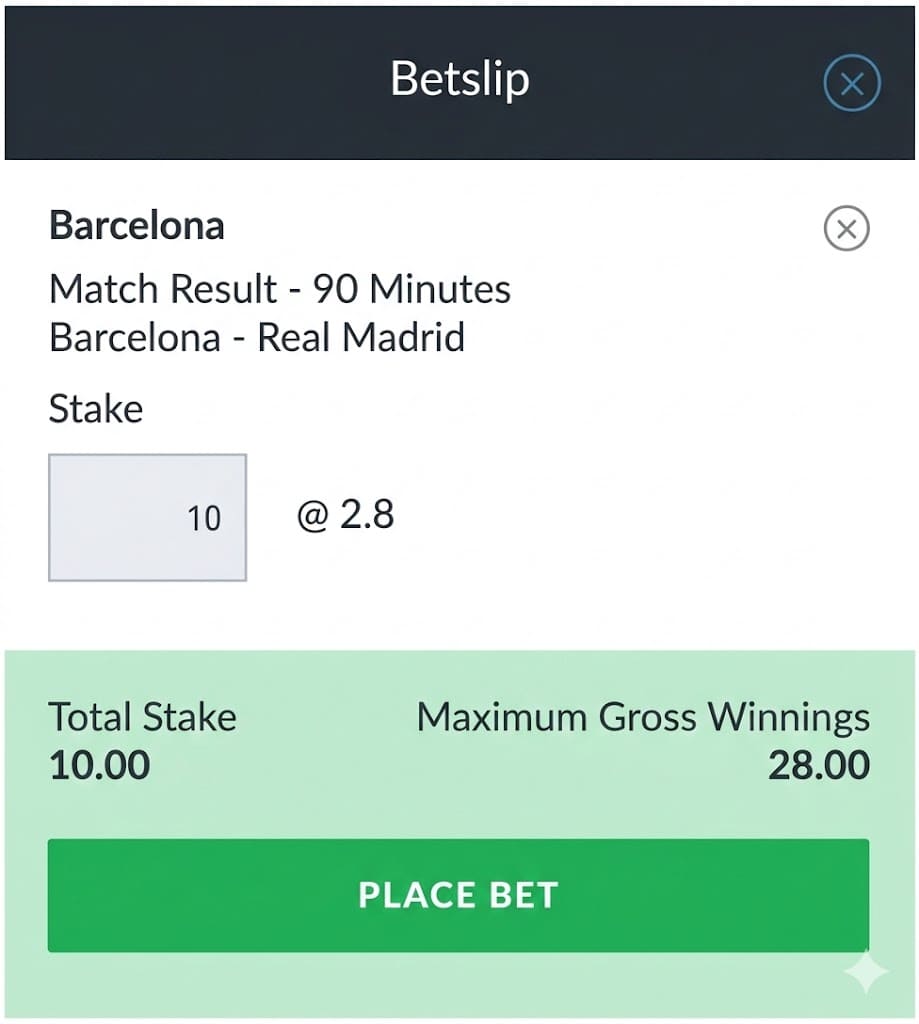
The 1X2 Single Bet
In this 1X2 single bet example, selecting 1 means betting on a Barcelona home win. If the bet wins, a stake of 1 unit at odds of 2.8 returns 2.8 times the original stake.
If you choose 2 (away win), winning odds of 2.3 return 2.3 times your stake.
If the match ends in a draw and you selected X, odds of 3.4 return 3.4 times your stake.
Based on the betting odds, the matchup between Barcelona and Real Madrid appears relatively balanced, with a slight advantage reflected for the away side.
» Register and bet now at Bet365
1X2 bets are typically settled based on the result after 90 minutes, including injury time. In a knockout competition, if the match is level at full-time and proceeds to extra time or a penalty shootout, the winning selection for the 1X2 market remains the draw (X), regardless of which team eventually progresses.
Accumulator Bet or Parlay Bet
An accumulator bet (also known as a parlay bet) combines multiple individual selections into one single wager.The total odds are calculated by multiplying the odds of each selection. The more matches you include in your accumulator, the higher the potential return — but the lower the overall probability of winning.
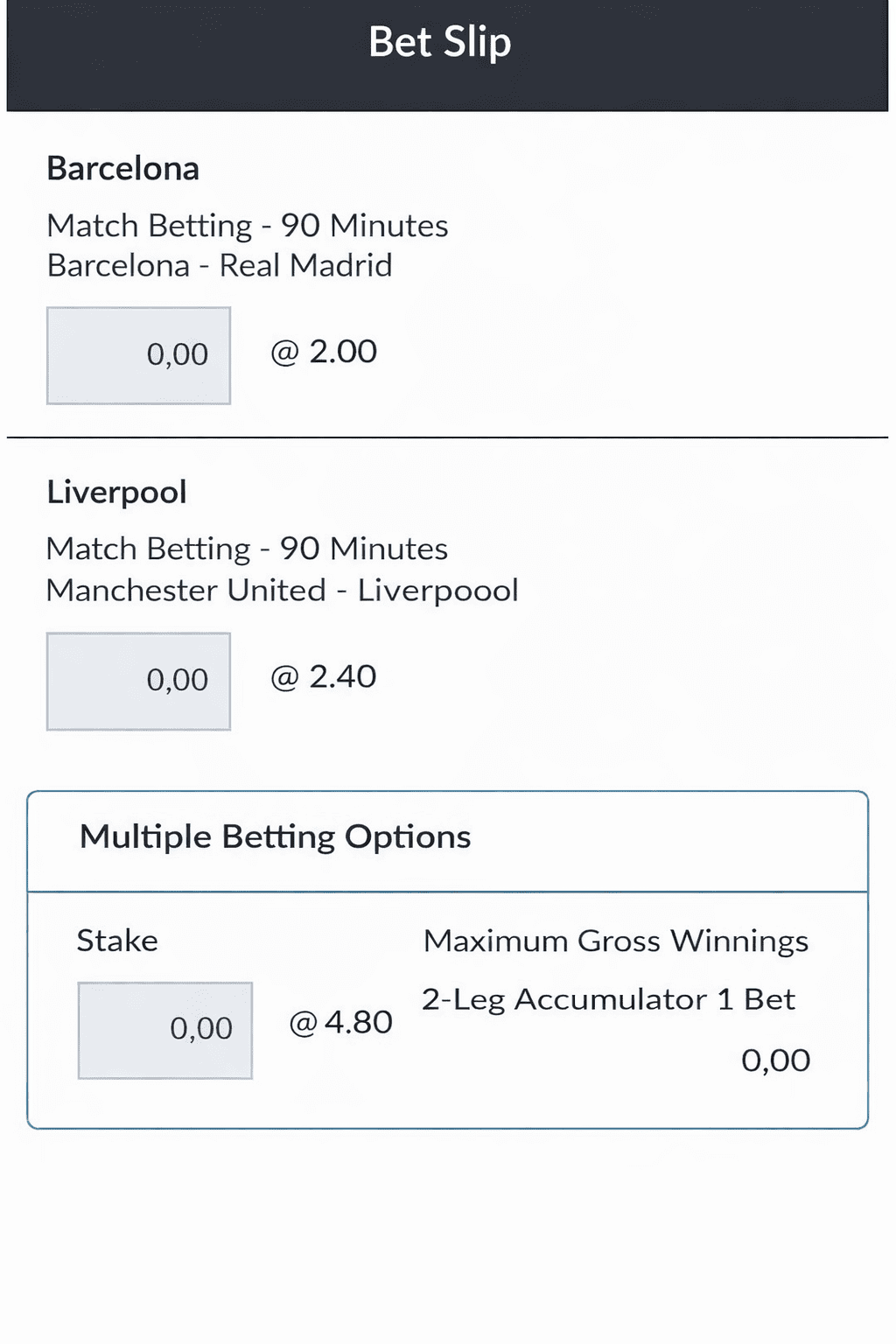
Accumulator Bet Example
In this example, two 1X2 selections are combined into one accumulator. Individual odds of 2.00 and 2.40 result in combined odds of 4.80 (2.00 × 2.40).
With a stake of €10, the potential return would be €48.
In addition to traditional 1X2 bets, different betting markets can be combined within the same accumulator, depending on the sportsbook.
Many bettors are tempted by high-risk long-term accumulator bets, for example on outright winners in competitions like the Europa League. The idea is simple: stake a small amount and aim for a very large payout due to extremely high combined odds. In reality, however, these long-shot accumulators rarely succeed. On the other hand, combining multiple favorites in standard 1X2 betting markets may seem safer. But to achieve high total odds, you need to include many selections — and the more matches you add, the higher the risk that one strong favorite only manages a draw instead of a win.
The System Bet
You already understand the difference between a single bet and an accumulator bet in sports betting. In this section, we explain a specific variation of the accumulator: the system bet.
The System Bet Explained
A system bet is a combination of multiple smaller accumulator bets. It allows you to lose one or more selections and still receive a return, depending on the system chosen.
There are many different system formats available, such as 2/3 (two out of three), 2/4, 3/4, up to 5/8 or 7/8. The exact range of system bets offered depends on the sportsbook.
The Comprehensive System Bet Overview
The following table provides an overview of the most common system bets in sports betting.
The column shows the total number of selections included in the system bet. The row indicates how many selections are combined per individual accumulator.
The matrix then displays the total number of bets generated by each system format.
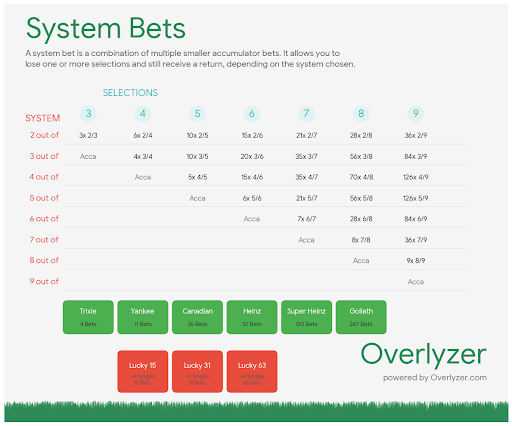
The Compact Overlyzer System Bet Overview
System Betting: What You Need to Know
- Combining multiple selections to boost your odds naturally increases the risk of a single ‘leg’ letting you down.
- In a standard accumulator bet, one losing selection means the entire betting slip is lost.
- With a system bet, the remaining accumulator combinations can still win even if one selection fails.
- As a result, a system bet usually lowers the maximum potential odds but increases the overall probability of achieving a return.
Handicap Betting
Handicap betting is one of the most popular and widely used betting markets in sports betting, especially in team sports. In this market, one team is given a virtual advantage or disadvantage before the match begins.
Like Over/Under betting, handicap bets are among the most common wagering options offered by sportsbooks.
Spread betting is closely related to handicap betting and is particularly popular in the UK, one of the key markets in the global sports betting industry.
Understanding the Handicap: How it Works
Suppose there is an international football match between England and France and you choose the England +1 handicap bet. This means that, for betting purposes, England starts the match with a virtual 1–0 advantage.
You can still place a bet on home win, draw, or away win — but the handicap is applied to the final result after 90 minutes.
This adjustment changes how each selection is evaluated once the handicap is factored into the final score.
England - France | Bet "England +1"
Pick 1 (England Win)
England starts the match with a virtual 1–0 lead due to the +1 handicap. To win with Pick 1 (England win), you need either an England victory or a draw. If the match ends 1–1, for example, the adjusted score becomes 2–1 to England, so the bet wins.
Pick X
To win with Pick X, France must win by exactly one goal. If the match ends 1–2, the adjusted score becomes 2–2 after applying the handicap, resulting in a winning draw selection.
Pick 2 (France Win)
To win with Pick 2, France must win by at least two goals. Because England starts with a virtual 1–0 lead, France needs a margin of two or more goals for the away win selection to succeed. If France wins 0–2, the adjusted score becomes 1–2. If France wins 1–4, the adjusted score becomes 2–4.
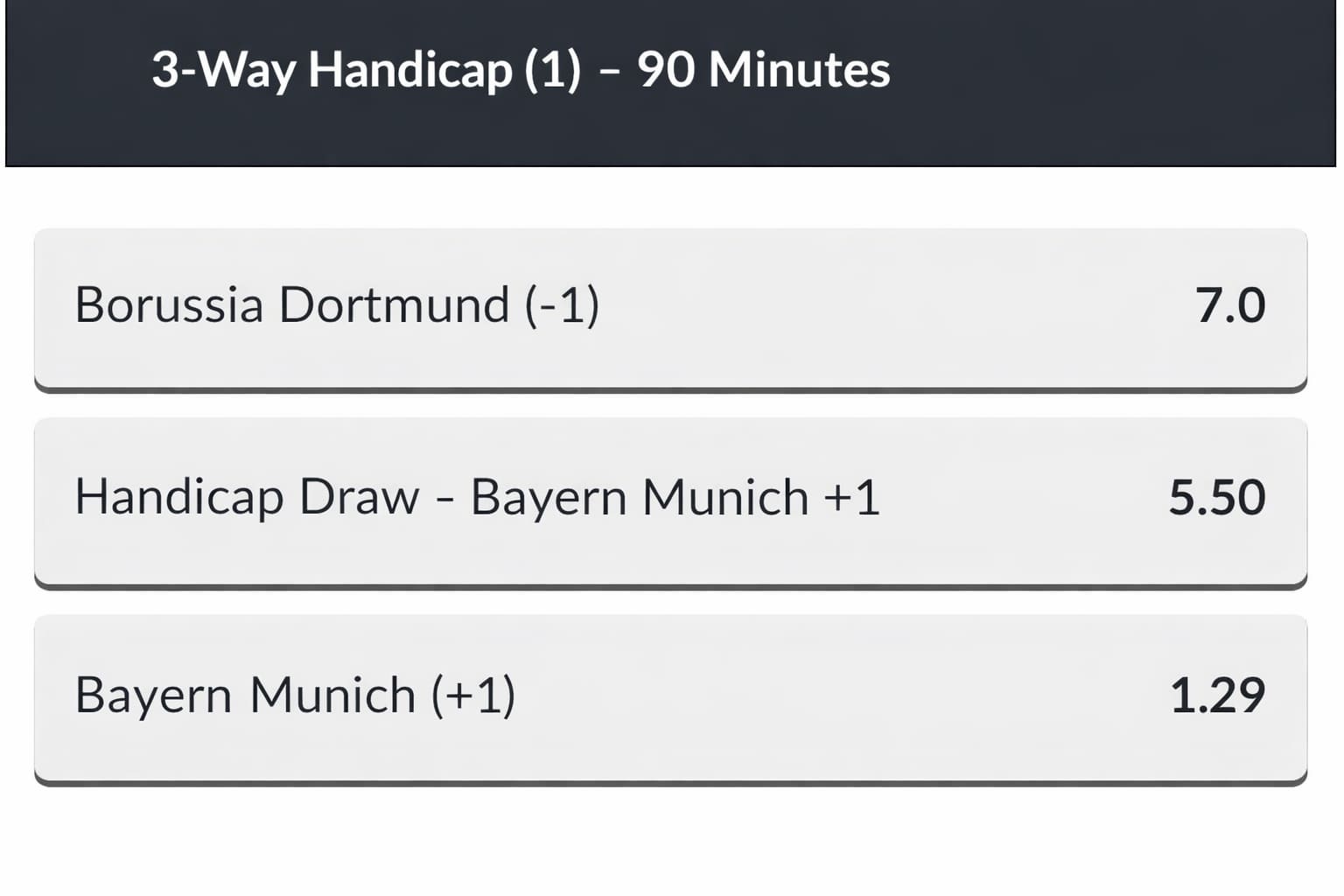
Handicap bets are among the most popular betting options in football and are offered by bookmakers across both major and smaller leagues. Here you can see an example from the German Bundesliga featuring Borussia Dortmund vs. Bayern Munich.
Similarly, you will encounter negative handicaps (e.g., -1), where a deficit is applied to the selected team. For instance, if you expect Borussia Dortmund to dominate and win by at least two clear goals, you would back them on the -1 handicap line. In this scenario, Dortmund must overcome their one-goal disadvantage for your bet to be successful.
Handicap markets aren’t limited to a single-goal margin. In fixtures featuring a heavy favourite, you’ll often find lines where a team is given a two or three-goal head start or deficit. These wider margins allow punters to find better value even when a match is expected to be one-sided.
Handicap betting is by no means exclusive to football. It is a mainstay of wagering on ice hockey, basketball, and American football, as well as many other disciplines. In these high-scoring sports, the handicap margins are significantly wider than in football, simply because the average number of points or goals scored per game is far higher.
Asian Handicap (AHC)
The Asian Handicap (often abbreviated as AHC) is a specialized form of handicap betting. Not all sportsbooks offer Asian Handicap markets, but this betting format has become increasingly popular in football betting.
Asian Handicap
In Asian Handicap betting, teams are not only given whole-goal handicaps, but also half goals, quarter goals, or three-quarter goal lines. These fractional handicap lines (such as -0.5, +0.25, or -0.75) change how the bet is settled and can result in a full win, half win, half loss, or refund depending on the final score.
» Bet on Asian Handicap at bet365
For beginners, Asian Handicap betting may seem confusing at first glance. On our dedicated Asian Handicap guide, we explain the different handicap lines in detail and show how they work in practice. With a bit of experience, this market can become a valuable tool in football betting strategy. In a separate section, we also cover Asian Over/Under betting and explain how these goal lines differ from traditional totals markets.
Over/Under Betting – A Timeless Classic
Over/Under betting is one of the most popular betting markets in sports betting, alongside the traditional match result bet and handicap betting. In this section, we explain what Over/Under betting is, how total goal lines work, and what you should consider before placing an Over or Under bet.
Over/Under Bets Explained
In Over/Under betting, you predict the total number of goals or points scored in a match. Using football as an example, a common market is Over 2.5 goals or Under 2.5 goals. If you bet on Over 2.5 goals, the bet wins once at least three goals are scored. If you bet on Under 2.5 goals, the bet wins if the match ends with zero, one, or two goals. As soon as a third goal is scored, the Under 2.5 bet loses.
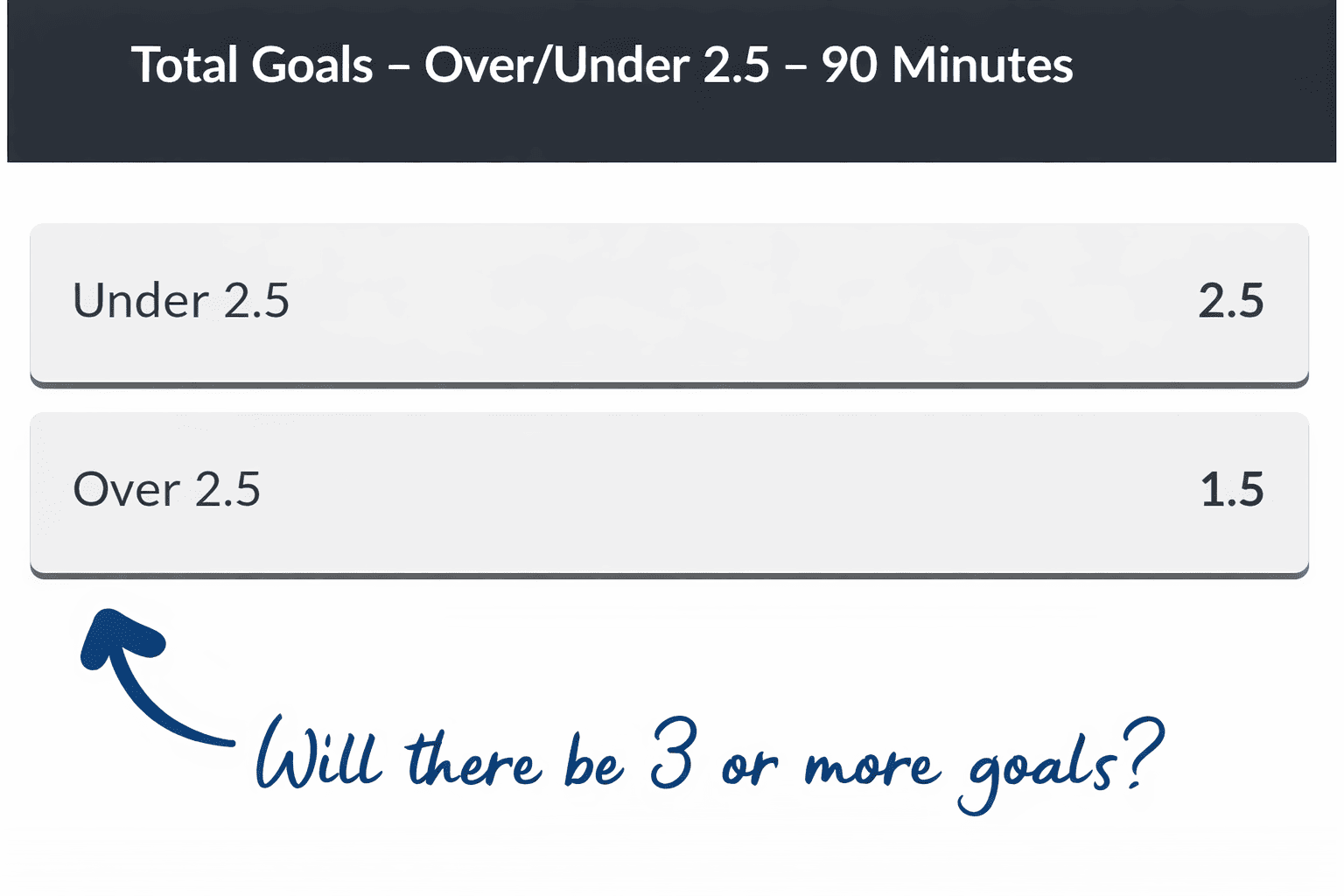
Over/Under Bet
For beginners in sports betting, half goals may seem confusing at first, since a football match cannot end with 2.5 goals. However, Over 2.5 goals is the standard market notation.It simply means that more than two goals must be scored — in other words, at least three goals are required for the Over 2.5 bet to win.Of course, there are different variations of over/under bets.
Over/Under betting markets are available in many different variations, especially regarding the total goals line. In football betting, most sportsbooks offer a wide range of pre-match goal lines — for example, Over 5.5 goals, which requires at least six goals for the bet to win.
Depending on the course of the match, even higher goal lines may become available in live betting. In addition, Over/Under bets can be placed on specific time periods, such as the first half, the second half, or the remaining match time in in-play markets.
Over/Under betting is available in almost every sport where goals or points are scored. In basketball betting, for example, the total points lines are naturally much higher — such as Over 172.5 points or Under 172.5 points. If you place a bet on Over 172.5, the wager wins once the 173rd point of the game is scored.
Over/Under betting is a popular strategy in sports betting because it allows bettors to analyze goal trends, scoring averages, and statistical patterns instead of relying solely on match outcomes.
In addition to traditional Over/Under goal markets, football betting also offers a variety of alternative Over/Under options that focus on specific match events rather than the final score. These betting markets follow the same basic principles as classic totals betting, but instead of total goals, they are based on other statistical metrics such as corners, cards, shots, or team-specific performance data.
Corner Over/Under
In Corner Over/Under betting, you predict the total number of corners taken in a match. This market follows the same principles as traditional Over/Under betting and forms the basis for a dedicated corner betting strategy. A common example is Over 9.5 corners, which requires at least ten corners in total for the bet to win. Corner betting can be particularly relevant in matches characterized by sustained attacking pressure, frequent wing play, and a high number of shots or blocked attempts.
In football, attacking phases result far more often in blocked shots or cleared crosses than in actual goals. As a result, the total number of corners in a match is usually higher than the number of goals scored. Because of this, corner statistics can sometimes provide a more stable reflection of attacking pressure and overall game flow than the final scoreline. Corner Over/Under betting therefore allows bettors to factor in offensive pressure and territorial dominance, independent of finishing efficiency. From a betting perspective, this can help reduce variance compared to relying solely on goal-based markets.
Card Over/Under
Another popular variation is Cards Over/Under betting. In this market, you predict the total number of yellow and red cards shown during a match. Card betting can be particularly relevant in fixtures characterized by high intensity, frequent duels, and repeated stoppages in play. Large-scale statistical analyses indicate that underdogs in matches with a clear favorite tend to receive more cards than the stronger side. In evenly matched games, however, the total number of cards often increases during high-pressure phases, such as when the scoreline is close or in the final stages of the match. Over/Under bets on cards therefore allow bettors to incorporate both team strength dynamics and expected match intensity into their betting analysis.
A Smart Strategy for Card Betting: Did you know that Overlyzer’s advanced filter tool allows you to quickly identify matches with a high number of yellow and red cards? This unique feature helps you identify high-intensity matches where tensions are boiling over, giving you a competitive edge when betting on ‘Total Cards’ or ‘Booking Points’ markets.
Over 1st Half Betting
Over/Under bets can also be placed specifically on the first half. In this case, only the goals scored during the first 45 minutes plus stoppage time are counted. From a statistical perspective, roughly 40 to 45 percent of total goals are scored in the first half, depending on the league and season. Across most competitions, however, more goals are typically scored in the second half than in the first. First-half Over bets can be particularly relevant for teams that start matches with high intensity, apply early pressure, and aim to take control from kickoff. Sides with an attacking style, aggressive pressing, or a clear favorite status tend to generate more early shots and scoring opportunities, increasing the likelihood of first-half goals.
Over 2nd Half Betting
Over/Under bets can also be placed exclusively on the second half, meaning that only goals scored after halftime are counted. Statistically, a larger share of total goals is scored in the second half compared to the first. This is often due to tactical adjustments, increased attacking intent, or teams reacting to the scoreline — for example, by making offensive substitutions when trailing. In matches with a clear favorite and underdog dynamic, the weaker side may remain competitive for long stretches. However, as the game progresses, physical and mental fatigue can increase. If the underdog concedes shortly after halftime, the match may open up, creating more space and increasing the likelihood of additional second-half goals.
Special types of Over/Under Betting
A well-known variation is the Asian Over/Under market, which introduces the possibility of a stake refund depending on the exact number of goals scored. For example, if you bet on Over 2.0 (Asian total), the bet loses if zero or one goal is scored. If exactly two goals are scored, the stake is refunded (push). The bet wins if at least three goals are scored.
There are also Asian goal lines with quarter-goal increments, such as Over 2.25 goals, which split the stake across two lines and can result in a half win or half loss depending on the final score.
In addition, Over/Under betting is available in long-term markets. Examples include predicting the total points a team will collect during a tournament or the total goals a player will score over the course of a competition.
Some sportsbooks also offer aggregated total markets, where bettors can place Over/Under wagers on the combined number of goals scored across multiple matches — for example, across an entire Bundesliga matchday.
Half Time / Full Time Betting
A Half-Time/Full-Time bet (HT/FT) requires you to predict both the result at halftime and the final result at full time. This betting market combines two match outcomes into one single wager. To win an HT/FT bet, both predictions must be correct. If your halftime selection is accurate but the final result differs, the bet loses. The same applies in reverse: a correct full-time result is not enough if the halftime prediction was wrong. This market is popular in football betting because it allows bettors to factor in match dynamics, early momentum, and potential second-half shifts in performance.
All Possible Half-Time/Full-Time Combinations in Football Betting
Half-Time bets are generally based on the standard three-way (1X2) betting market. This means that the halftime result is predicted using the same simple selections: 1 (home win), X (draw), or 2 (away win).
Below you will find an explanation of all nine possible Half-Time/Full-Time (HT/FT) betting combinations in football betting.
1/1 – The home team leads at halftime and wins the match.
1/2 – The home team leads at halftime but loses the match.
1/X – The home team leads at halftime and the match ends in a draw.
X/1 – The match is level at halftime and the home team wins.
X/2 – The match is level at halftime and the away team wins.
X/X – The match is level at halftime and ends in a draw.
2/1 – The away team leads at halftime but the home team wins the match.
2/2 – The away team leads at halftime and wins the match.
2/X – The away team leads at halftime and the match ends in a draw.
Why Half-Time/Full-Time Betting Odds Vary So Much
Within the nine possible Half-Time/Full-Time (HT/FT) combinations, betting odds often vary significantly. In most cases, it is more likely that the pre-match favorite leads at halftime and goes on to win the match. However, this outcome is far from guaranteed, which is why HT/FT markets frequently show wide differences in pricing across the available selections.
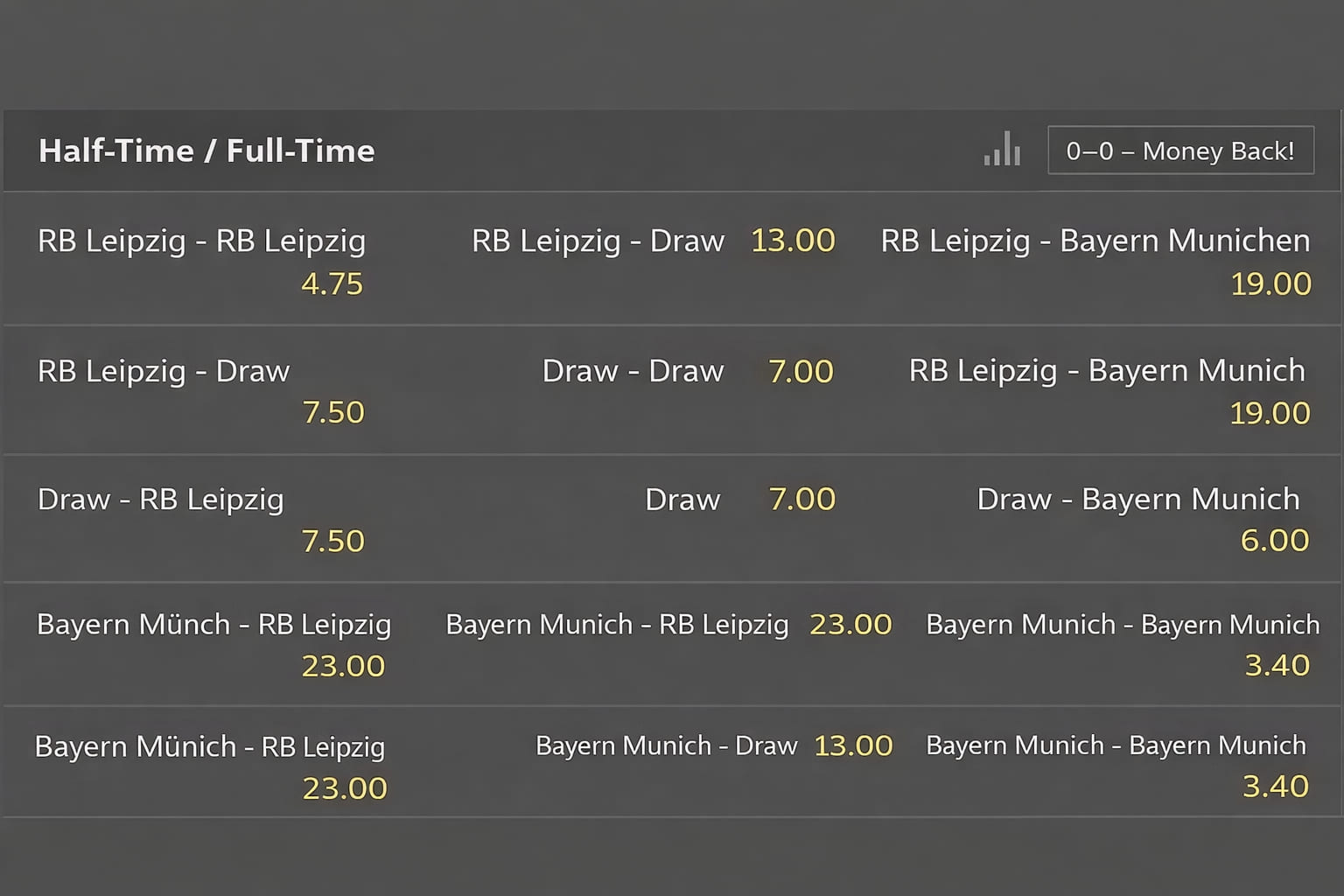
Bet365 odds for the Half-Time/Full-Time bets for the match RB Leipzig vs. Bayern Munich in the German Bundesliga.
Favorites often struggle at the beginning of a match and may not be leading at halftime. This frequently occurs when teams rotate their lineup after a demanding previous fixture and need time to find their rhythm.
Even against generally well-organized defensive teams, it can happen that a clear favorite goes into the break with the score level.
Conclusion: Half-Time/Full-Time Betting
With significantly higher odds compared to standard match betting, Half-time/Full-time (HT/FT) markets offer a compelling incentive. If you feel you can accurately anticipate the flow and narrative of a match, this betting type is a highly suitable option.
Due to the way these prices are calculated, profit-oriented punters often focus on single bets when using this market. While combining multiple HT/FT picks across different matches offers the potential for a massive payout—provided you have the right expertise—it naturally carries a significantly higher risk of losing your stake.
Double Chance Betting
Double Chance is a betting market where two of the three possible outcomes result in a winning bet. Alongside Over/Under markets, it is a fan-favourite for punters who value security over high-risk volatility.
In traditional 3-way betting, you choose between 1X, 12, and X2. While the odds are naturally lower than a standard win bet, Double Chance is a top-tier option for "playing it safe" or hedging your risk. Here is how it breaks down:
- 1X (Home or Draw): Your bet is successful if the home side wins or the match ends in a stalemate. If the away team wins, the wager is lost.
- 12 (Home or Away): You win if either team secures a victory. The bet is settled as a loss if the game ends in a draw.
- X2 (Away or Draw): Your bet wins if the visitors either win or the match ends in a draw. If the home team wins, the bet is lost.
Some sportsbooks also offer combined markets where a Double Chance selection is linked with an additional condition. A typical example is “1X and at least one team does not score.” This bet wins only if the home team wins or the match ends in a draw and at least one team fails to score. For example, the bet would lose in a 2–1 home win or a 1–1 draw, because both teams scored in those scenarios.
Both Teams to Score (BTTS)
The "Both Teams to Score" market—widely known as BTTS—is one of the most popular specialist wagers in football betting. The concept is straightforward: your bet wins as long as both teams find the back of the net at least once, regardless of the final result. Scorelines such as 1–1, 2–1, 3–2, or 2–2 all result in a winning BTTS bet. Results like 1–0 or 0–0, however, lead to a losing wager. BTTS betting is particularly attractive because it is less dependent on predicting the exact match outcome compared to traditional result markets. Instead, it can be effectively combined with statistical analysis, goal trends, and tactical evaluation.
When is the BTTS Betting Particularly Profitable?
BTTS betting is particularly relevant in matches where two offensively oriented teams face each other — ideally sides that are also vulnerable defensively. Teams that apply high pressing, build up aggressively, or defend with a high line tend to create scoring opportunities but also leave space for the opponent. When two such playing styles meet, the probability that both teams score increases.
Across Europe’s top leagues, the historical BTTS hit rate typically ranges between approximately 55 and 67 percent over multiple seasons. In many competitions, more than every second match ends with goals from both sides. This relatively high baseline frequency explains why BTTS is one of the most popular football betting markets.
However, selective use is essential. Matches in which both teams regularly generate high-quality chances offer a stronger foundation for BTTS betting than games dominated by one side with limited attacking contribution from the opponent. Fixtures characterized by alternating pressure phases and balanced possession dynamics are often particularly relevant, as they indicate an open contest with scoring potential on both ends.
The right time for a Both Teams to Score bet
Another key factor in BTTS betting is timing. Matches often remain goalless in the opening phase, even when both teams start aggressively and create early chances. If no goal is scored in the first 10 to 15 minutes, the odds for Both Teams to Score typically increase — even though the underlying match dynamics may not have changed.
When both sides play offensively, push forward with intent, and generate chances at both ends, in-play BTTS markets can offer improved value compared to pre-match prices.
In this context, analyzing match flow is more important than focusing solely on the current scoreline. What matters is the intensity, territorial pressure, and frequency of dangerous situations. If both teams consistently enter attacking zones and the match remains balanced rather than one-sided, the probability of goals at both ends stays elevated — regardless of whether a goal has already been scored.
Live data visualization tools, such as pressure or momentum graphs, can help identify phases where the character of the match differs from the scoreboard. In particular, goalless matches with sustained attacking pressure from both teams may present favorable conditions for BTTS decisions.
Draw No Bet (DNB)
Draw No Bet (DNB) is a betting market in which the draw option is removed. You place a bet on one team to win, and if the match ends in a draw, your stake is refunded.
This market is commonly abbreviated as DNB, but it is also referred to as AHC 0 or Asian Handicap 0, as it functions similarly to a zero handicap line. Some sportsbooks translate the term directly and offer it under labels such as “No Draw Bet” or similar wording.
Unlike a traditional three-way (1X2) bet — where you can select 1, X, or 2 — the win odds in a Draw No Bet (DNB) market are typically lower. The reason is the built-in “draw protection”: if the match ends level, your stake is refunded instead of lost. As a result, DNB betting reduces downside risk compared to a standard 1X2 bet, although it comes at the cost of lower potential returns.
In concrete terms, a DNB bet works as follows:
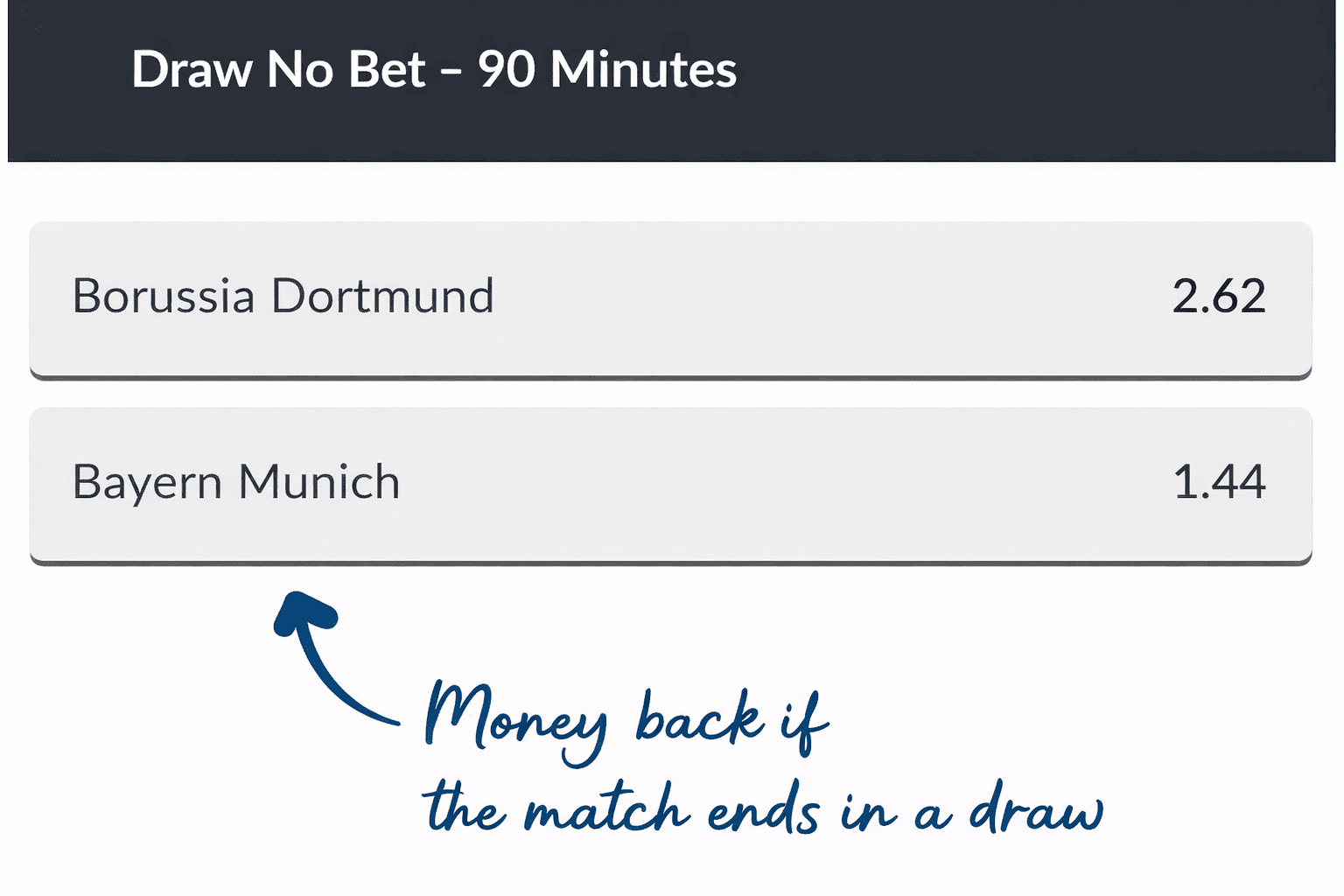
Team 1 – Draw No Bet (DNB): The bet wins if the home team wins. If the match ends in a draw, the stake is refunded. If the away team wins, the bet loses.
Team 2 – Draw No Bet (DNB): The bet wins if the away team wins. If the match ends in a draw, the stake is refunded. If the home team wins, the bet loses.
Scorecast and Wincast Betting
Scorecast and Wincast bets are among the most dynamic and engaging football betting markets, particularly for fans following a match live. These combined bets often offer higher odds, as they require multiple outcomes to occur in the same game.
Both markets are based on the occurrence of two events within a single match. In a Scorecast bet, you predict not only the correct final score, but also which specific player will score during the match.
The goal scorer selection in Scorecast betting can be structured in different ways. The most common Scorecast markets include:
- Correct score and Player X scores the first goal
- Correct score and Player X scores the last goal
- Correct score and Player X scores at any time during the match
The most common form of Scorecast betting combines the correct final score with the first goal scorer of the match.
Like bets on the last goal scorer, selecting the first goal scorer in combination with the correct score typically comes with higher odds, as two specific events must occur within the same match.
If you bet on a player to score at any time during the match, the odds are usually lower. This is because the timing of the goal does not matter for the bet to win — the player simply needs to score at any point within the 90 minutes of regular time.
Wincast betting is also challenging, but generally less complex than a Scorecast bet.
In a Wincast bet, you select a goal scorer — in the same variations described above (first goal scorer, last goal scorer, or anytime goal scorer) — and combine this with the match outcome in the standard three-way (1X2) market: home win, draw, or away win.
While this still requires two correct predictions within the same match, it is typically less demanding than a Scorecast bet, where you must correctly predict both the exact final score and the goal scorer.
How to Choose the Right Scorecast or Wincast Bet
Scorecast and Wincast bets are usually placed pre-match, meaning research and structured betting analysis are essential. To improve your decision-making, it helps to follow a systematic approach rather than relying on intuition.
Unlike many other betting markets, placing these bets very early is not always an advantage. A lot can change before kickoff, and in most cases it is crucial that your selected goal scorer is actually in the starting lineup.
Especially when including star players in a Scorecast or Wincast bet, it is not always guaranteed that they will start or even feature in the match. Against weaker opponents, key players are often rested, and lineup decisions can change shortly before kickoff. Even during the warm-up, unexpected injuries or last-minute adjustments can occur, which may directly impact goal scorer betting markets.
For this reason, it is generally advisable to wait until around one hour before kickoff to place a Scorecast or Wincast bet. This is typically when the official starting lineups are announced. If your selected goal scorer is confirmed in the starting XI, the foundation for your bet is significantly stronger. As with all pre-match betting strategies, it is important to consider the broader context. Even the most prolific striker may struggle to score if surrounded by heavily rotated or reserve players. Team quality, tactical setup, and overall match dynamics remain decisive factors.
When selecting a suitable goal scorer, there are several possible approaches. The team’s leading scorer is often the most obvious choice, and evaluating recent form — whether the player is on a scoring streak or experiencing a drought — is relatively straightforward. However, other players can also offer value in goal scorer betting markets, depending on their role, positioning, and involvement in attacking phases.
Before kickoff, ask yourself a few key questions when evaluating a Scorecast or Wincast bet:
- Who are the designated penalty takers for both teams?
- Is there a reliable free-kick specialist on the pitch?
- Which dynamic wingers or attacking players could exploit weaknesses in the opposing defense?
- Are there goal-scoring defenders in either team — and does the side regularly score from set pieces such as corners?
- Is your selected goal scorer likely to play the full 90 minutes, or is he a candidate to be substituted early?
- What is the player’s historical record against this opponent? Has he scored frequently against this team?
- Does your chosen goal scorer tend to score early in matches, or is he more effective in the second half?
- How strong is the direct opponent or defensive matchup your player will face?
Carefully evaluating these factors can improve the quality of your betting analysis and help you identify stronger Scorecast or Wincast opportunities. Because these combined bets carry higher inherent risk, accurate assessment of lineup roles, set-piece responsibilities, and match context can also justify higher betting odds in relation to the probability of the outcome.
Win and Place Bets in Football
The win bet is the foundation of every sportsbook and is available for virtually every sporting event. Less commonly associated with football betting, however, is the place bet — a market traditionally linked to horse racing.
Both betting types originate from horse racing markets, where the place bet developed as an extension of the classic win bet. The key difference lies in risk exposure: because a place bet does not require an exact winning prediction, it generally carries lower downside risk compared to a pure win bet.
In football sportsbooks, the concept appears in adapted formats rather than as a direct “place bet.” In the following section, we explain how this market structure translates into football betting and how it relates to the traditional win bet.
The Place Bet: Explanation and Use in Football Betting
The place bet was originally introduced in horse racing to reduce the risk associated with a pure win bet, which requires an exact prediction of the winner. Instead of selecting the outright winner, a place bet asks which participant will finish in a specified top position.
Depending on the size of the field and the race format, a “place” in horse racing typically means finishing in the top two, top three, or top four.
Ultimately, the exact definition of a qualifying place is determined by the event organizer or sportsbook. There is no universal standard for place betting rules, and bookmakers use this flexibility to structure their markets differently.
In football betting, this concept is often adapted to season-long or special markets. For example, some sportsbooks offer Bundesliga place markets where a team must finish within a defined top position range to settle the bet as a win:
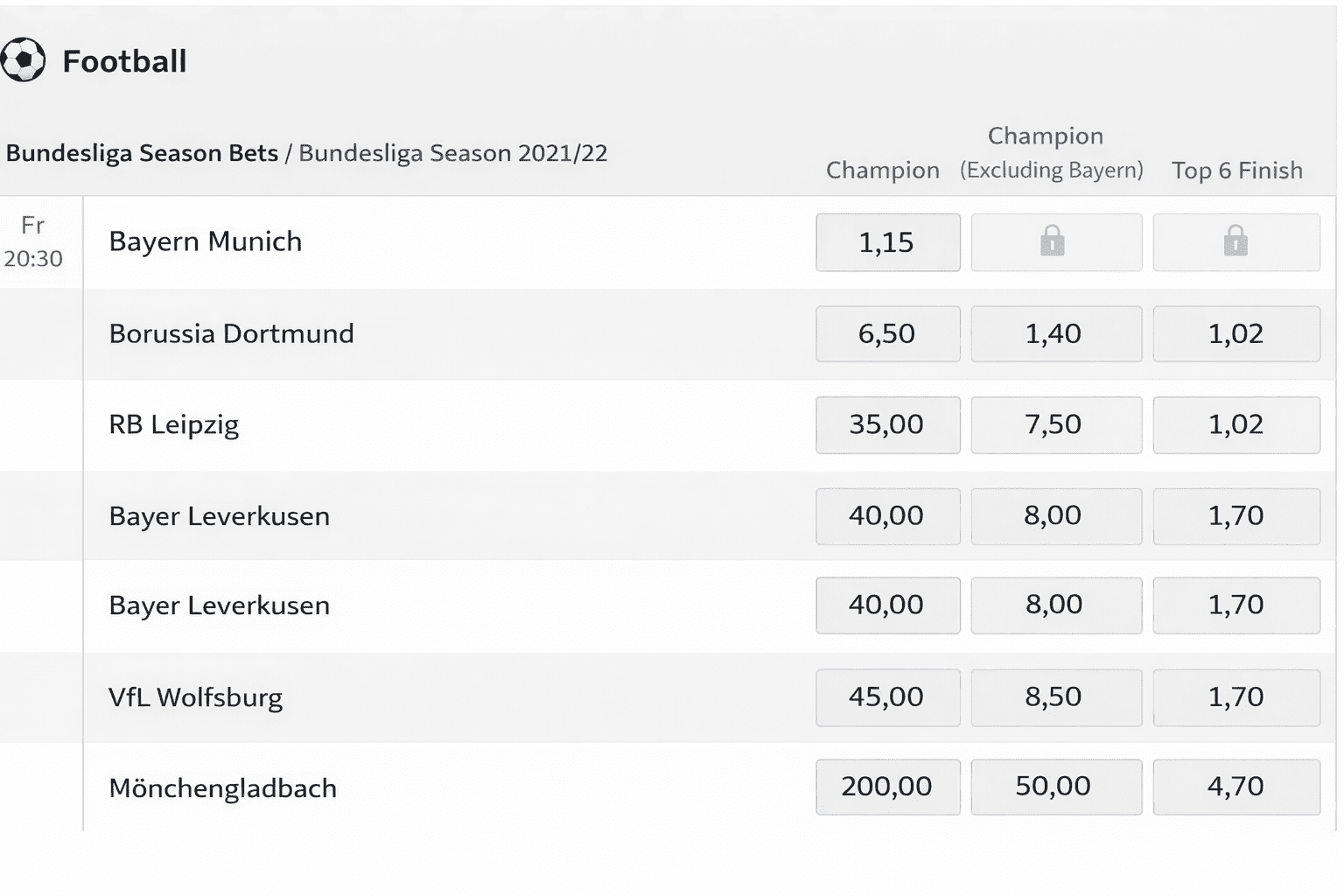
Win and Place Bets in Bundesliga Outright Betting at Tipico
The example illustrates that bettors effectively trade lower risk for lower odds when choosing a place bet instead of a win bet. The reduced downside risk typically comes with comparatively modest returns.
While higher stakes can offset lower odds in absolute terms, it is important to remember that outright and season-long bets tie up capital for an extended period. The invested stake remains locked in until the market is settled.
Place markets that extend as far as sixth position, for example, represent an especially broad interpretation of the traditional place bet concept and significantly alter the risk–reward profile compared to classic win betting.
Conclusion and Summary
In terms of origin and structure, win and place bets are traditionally associated with horse racing markets. The win bet requires an exact prediction of the winner, while the place bet offers more flexibility by allowing a defined margin for deviation in the final result.
As with most betting markets, there is a trade-off: the higher probability of success in a place bet comes at the cost of lower odds compared to a pure win bet.
When applied to football betting — typically in the form of outright or season-long markets — both win and place bets share the inherent uncertainty of long-term predictions. Squad changes, injuries, fixture congestion, and tactical developments can significantly influence outcomes over the course of a season or tournament, which limits the reliability of early forecasts.
Goal Markets, Goalscorer Bets, and "First Goalscorer”
Under the collective term "Goal Markets," football sportsbooks offer a range of selections that share one commonality: they all focus on the goal—the central element on the pitch that determines the outcome of the match. Teams chase it relentlessly, while the crowd eagerly anticipates the next strike.
Therefore, the immense popularity of goal markets among football punters is just as unsurprising as the fact that bookmakers cover hardly any other area as extensively as goal betting. In this article, we will present these markets in all their variety and full spectrum.
Categorising the Different Types of Goal Bets
Online bookmakers demonstrate a high degree of creativity across the goal markets in their sports betting offerings. To maintain a clear overview, it is well worth classifying these various options into distinct categories.
First and foremost, it should be noted that goal bets appear in the form of 2-way, 3-way, and multi-way (multi-outcome) markets. The most significant insight derived from such a classification relates, of course, to the win probability and the associated risk of loss: the fewer the potential outcomes, the higher the probability of success for an individual selection.
Naturally, goal markets can also be distinguished thematically by their specific focus. This may center on the total number of goals, the timing of the goals, or the specific goalscorers. Most goal-related bets can be accurately categorised according to this breakdown.
- Goal Markets Focusing on the Number of Goals
- Goal Markets Focusing on the Timing of the Goal
- Goal Markets Focusing on the Goalscorer
- Specialist Goal Betting Markets in Football
- Goal Betting in Other Sports
Additional Goal-Related Betting Markets in Football
The topic of goal totals can be approached from several different angles: Will the total number of goals scored in the match be odd or even? Does the home or away team score 0, 1, 2, 3 times or more? Will more goals be scored in the 1st or the 2nd half, or will the goal count be equal?
Also highly popular are markets that can be answered with a simple "Yes" or "No". Because there are only two possible betting outcomes, these types of wagers offer a comparatively high probability of winning:
These are also offers with a comparatively high winning chance because there are only two betting options:
- Home Team to Win to Nil – Yes/No?
- Both Teams to Score 2 or More Goals – Yes/No?
- Both Teams to Score at Least One Goal – Yes/No?
- Both Teams to Score in the 2nd Half – Yes/No?
Spread Betting
Spread betting has its origins in financial markets and was developed in the 1940s by Charles K. McNeil, a mathematics professor who later became a professional bookmaker.
In sports betting, spread bets focus on the margin between predefined variables — most commonly the point or goal difference between two teams. As the name suggests, the bet revolves around a projected spread rather than a simple win or loss outcome.
In European sports betting markets, spread betting is primarily known and marketed as handicap betting. Sportsbooks typically present these markets as goal or point handicaps rather than using the term “spread.”
How does Spread Betting work?
The term “spread” can be translated as range or margin. In sports betting, it refers to estimating and pricing the expected difference or quantity of specific match variables.
There are numerous variables that can be used in spread betting. In football betting, common examples include total goals, number of cards, and set-piece situations such as corners or throw-ins. In other sports, spreads may apply to sets won in tennis or total points scored in a basketball game.
If a bettor expects more or fewer of a specific event to occur, they place a wager based on the projected spread.
For example, in card betting, a sportsbook might set a spread of 3–4 yellow cards for a football match. If you anticipate a calm match with fewer disciplinary incidents, you would bet on Under 3–4 yellow cards. If you expect an intense and physical contest, you might choose Over 3–4 yellow cards, meaning at least five bookings would need to occur.
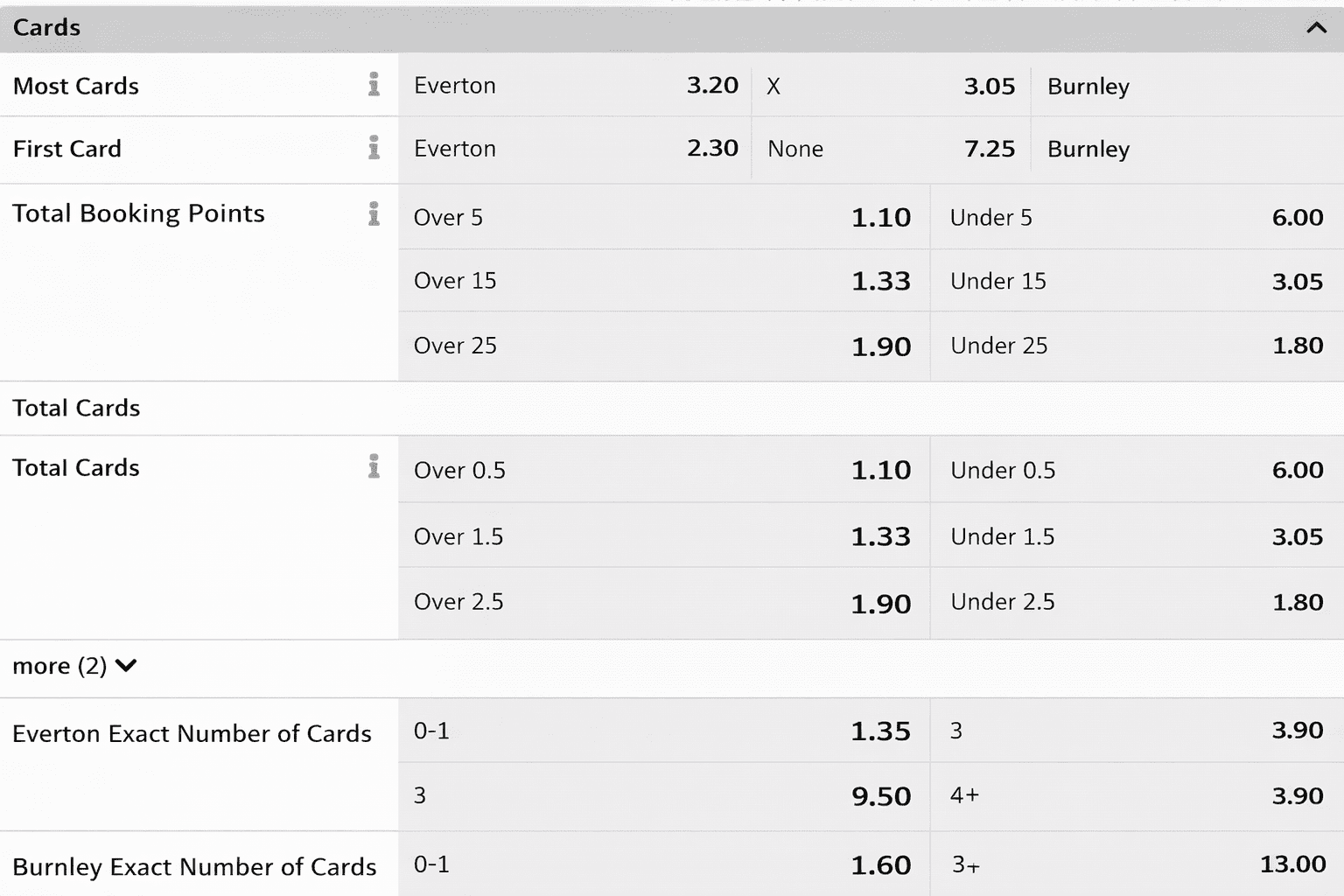
Interwetten provides multiple football betting options focused on total cards, including markets for yellow cards, red cards, and combined card totals.
Asian Betting Markets
Asian betting is particularly popular in football because it operates with specific thresholds that allow for refunds (pushes) as well as half-wins or half-losses. The two most significant markets are the Asian Handicap and the Asian Goal Line (often listed as Asian Over/Under). Both bet types ensure that draws or hitting an exact threshold do not automatically result in a straight win or loss.
The difference compared to the classic 3-way market is fundamental: In 1X2 or 3-way handicap betting, there are three possible outcomes (Home, Draw, Away). With Asian Handicaps, the use of half and quarter lines reduces the outcomes to just two, because a draw is effectively eliminated once the handicap has been applied.
Asian Handicap: 0.0, ±0.5, ±1.0, and Quarter-Lines
In Asian Handicap betting, the match result is mathematically adjusted by assigning a goal advantage or deficit to a specific team. Full lines such as 0.0, -1.0, or +1.0 can result in a "Push": if the handicap-adjusted score is exactly a draw, the stake is refunded. A typical example is Asian Handicap -1.0: if the team wins by two or more goals, the bet is successful; if they win by exactly one goal, it is a Push; in the event of a draw or a loss, the wager is lost.
With half-goal handicaps like -0.5 or +0.5, a Push is impossible because a "half-goal" can never be met exactly by a real-world scoreline.
Quarter and three-quarter lines (e.g., -0.25, +0.75, -1.25) automatically split the stake between two adjacent lines. An Asian -0.25 handicap splits the stake into two equal parts: one half is placed on Handicap 0.0, while the other half is placed on Handicap -0.5. In the case of a draw, this results in a "half-loss" (0.0 = Push, -0.5 = Loss). For a -1.25 line, the stake is split between -1.0 and -1.5, ensuring that a narrow one-goal victory does not result in a full win or a full loss.
Asian Over/Under (Asian Goal Lines): 2.0, 2.5, 2.25, 2.75
The same principle applies to total goals. Over/Under 2.0 results in a "Push" if exactly two goals are scored. Over/Under 2.5 has no Push: the bet is won with three or more goals and lost with 0–2 goals.
Quarter lines are particularly interesting because they help to smooth out variance. Asian Over 2.25 is a split between Over 2.0 and Over 2.5. If exactly two goals are scored, the Over 2.0 half is a Push and the Over 2.5 half is lost, resulting in an effective half-loss. With three or more goals, both halves win. Asian Under 2.25 works in the same way: with exactly two goals, the Under 2.0 half is a Push and the Under 2.5 half wins, resulting in a half-win.
Asian Over 2.75 splits the stake evenly between Over 2.5 and Over 3.0. If exactly three goals are scored, the Over 2.5 half is won, while the Over 3.0 half is refunded—the final result is a half-win.
Strategies for Asian Betting
The decisive factor is choosing the appropriate threshold. If you expect between two and three goals, Asian Over 2.25 is often more sensible than Over 2.5, because exactly two goals do not lead to a complete loss. If you anticipate a high-scoring match, Asian Over 2.75 can be an excellent alternative to Over 3.0, as three goals still result in a partial payout.
The logic behind Asian Handicap follows the same principle. For slight favorites, Asian 0.0 is frequently played because the stake is refunded in the event of a draw. For underdogs, the +0.75 line is particularly interesting, as a narrow one-goal defeat does not automatically result in a total loss of your stake.
Ultimately, it is crucial to align the selected goal or handicap value with your own analysis—for example, by using xG data or comparing your findings with market odds. Quarter values should be used deliberately to manage risk and control volatility.
The Banker in Sports Betting
In sports betting, the term “banker selection” refers to a pick that is considered highly likely to win. It does not relate to a financial institution. Instead, it describes a selection that bettors treat as a strong foundation within a broader betting strategy.
What does Banker mean in sports betting?
If you only place single bets, you do not need to use this feature, as the Banker option is only available for system bets. In a system bet, similar to an accumulator, you bet on the outcome of several matches. However, the difference is that not all of your predictions must be correct to win. For example, you can place a 3 out of 5 or 4 out of 7 system bet. In a 3 out of 5 system, the sportsbook automatically creates 10 different combinations from your five selections. In a 4 out of 7 system, 35 combinations are generated from the seven selections.
You can modify these system bets by using a Banker. If you are very confident that one or more of your selections will definitely win, you can set them as a "Banker." Once a selection is marked as a Banker, it must win. If the Banker selection fails, the entire bet is lost, regardless of whether the other parts of the system were correct. The primary advantage of a successful Banker is that the odds of every individual combination within your system are multiplied by the Banker's odds. This significantly increases the potential payout of the entire wager.
You should be very cautious when using a Banker in a system bet. Because the rest of the system becomes irrelevant if the Banker selection is wrong, the risk is much higher. However, when used correctly, Bankers are a powerful tool to increase your total odds.
The Outright (Long-term Bets)
During the summer months, there are typically fewer matches available because teams are in their off-season or recovery periods. Despite this, many betting enthusiasts still want to place wagers during this time.
While it is possible to bet on other sports or unfamiliar leagues, many people prefer to rely on their specific expertise in their favorite sport.
This is where outright bets (also known as long-term bets) come into play. They are often used as personal predictions to test a bettor's long-term knowledge. Most sports fans have likely debated with friends before a season starts about where their team will finish in the final standings.
The Advantages of Outright Bets
Due to the long duration of these wagers, the level of excitement is not as constant as it is with a single-match bet. However, that thrill returns in full force when the final matchday of the season decides the outcome of your long-term prediction.
The odds offered for this type of betting are one of the strongest arguments for including them in your strategy. High potential returns often outweigh the long waiting period.
A famous example of how lucrative long-term bets can be is Leicester City winning the Premier League title in the 2015/16 season. While few expected "the Foxes" to take the trophy, bold bettors were rewarded with massive odds of 5,000/1. A €10 stake resulted in a €50,000 payout. This proves that betting on an underdog in the outright markets can be highly rewarding.
The 5 Most Popular Outright Bets by Betting Volume
- Who will be World Champion
- Who will be European Champion
- Who will be top scorer at World or European Championships
- Who will win the Champions League
- Who will be German champion